How album reviews work is simpler than the mystery around them suggests: a critic listens to a record several times, describes what they hear, and explains why they think it works or doesn't. The judgment is the critic's own, but the evidence behind it — arrangement, performance, production, sequencing — is there for any careful listener to check.
What follows is a map of those criteria, a look at where scores come from, and some practical steps for reading a review past its number. Our analysis draws on how the album itself is defined and measured, because a review's first job is to judge the thing as it actually exists.
Start with the object under review. According to Wikipedia, an album is a collection of audio recordings issued on a medium such as CD, vinyl, tape, or digital format, and it was the dominant unit of recorded music from the mid-1960s through the early 21st century — the period the industry calls the album era. That framing matters. A review of an album is a judgment about a whole: sequencing, pacing, the arc from first track to last. A review of a single is a different animal, and good criticism keeps the two apart.
What does a critic actually listen for?
The first pass is usually about the writing and the performance: does the song carry a melody worth remembering, does the singer or soloist make a choice you haven't heard before? The second pass is about craft. How are the tracks ordered? Does the record breathe, or does it crowd itself? Where does an arrangement change — the bar where a verse drops to voice and one instrument, the chorus that arrives a beat later than you expect?
The third pass is about production, which is where most listeners' attention fades first. A review that only says a record sounds "warm" or "polished" has told you little. A useful one names the decision: the reverb placed on a vocal, the way the drums sit behind the bass, the moment a mix suddenly opens up. If you want to train your own ear for this layer, our guide to hearing the production details most listeners miss breaks the habit of letting a record wash over you.
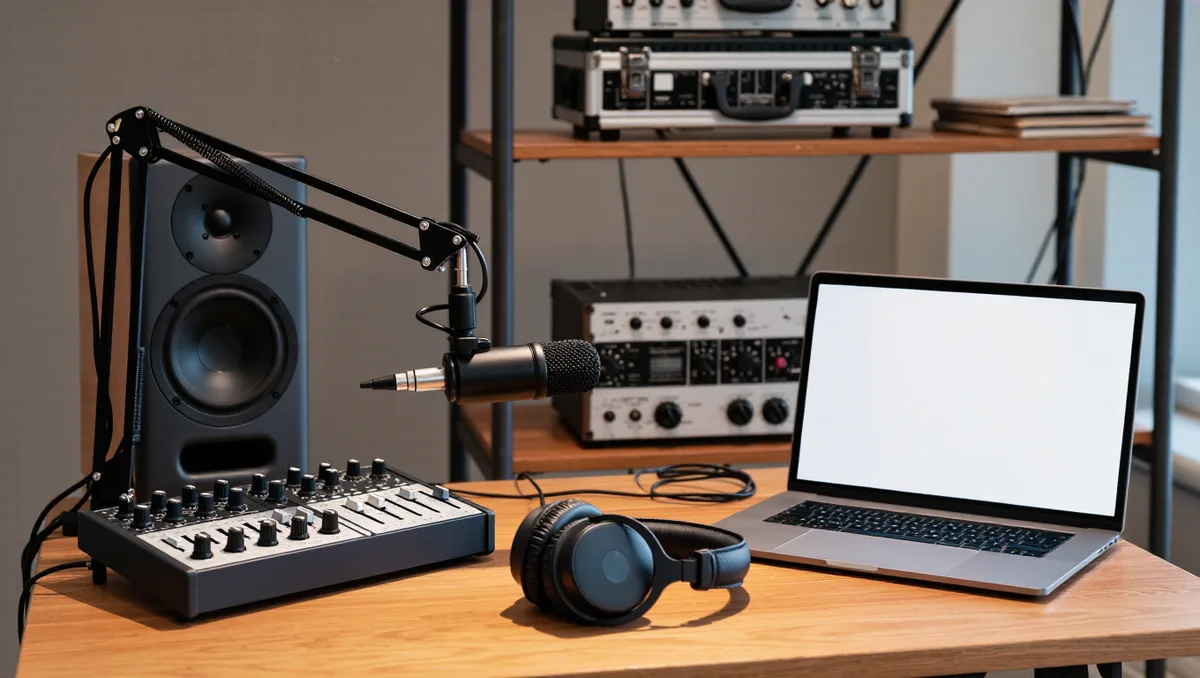
None of this requires gear obsession. A modest setup is enough to hear arrangement and sequencing clearly; what a review asks of you is attention, not equipment.
How does a score get assigned?
Scores are editorial conventions, not measurements. There is no industry standard scale, no calibrated instrument. A 7 out of 10 at one publication may mean "good, with reservations"; at another, "very good indeed." Some outlets have dropped numbers entirely, arguing that a verdict in words is harder to skim but harder to misread.
What a score usually encodes is a reviewer's weighing of several axes at once: ambition, execution, originality, and the simple question of how much the writer wants to return to the record. Because those axes get collapsed into one number, two records with the same score can deserve it for opposite reasons. That is the core argument for reading the review and not just the grade — a point we develop at length in our piece on what makes an album review trustworthy.
There is a second kind of number worth distinguishing: the chart figure. According to Billboard, its 200 chart ranks the week's most popular albums as compiled by Luminate, using multi-metric consumption that blends traditional album sales, track equivalent albums, and streaming equivalent albums. Popularity and quality are different claims. A review that cites chart position is describing reach, not merit, and a trustworthy review keeps that distinction visible.
Why does context carry so much weight?
A record never arrives alone. It lands next to an artist's earlier work, next to what their peers released that year, and next to the traditions it borrows from or pushes against. A critic who ignores context can only describe; a critic who uses it can explain why a record matters now.
Context also covers the physical and commercial facts. According to Merriam-Webster, an album is a collection of one or more audio recordings presented as a single unit, typically longer than a single or an EP. That definition leaves a lot of room — records have run from well under half an hour to well over an hour — and reviewers weigh whether the length serves the material. A tight thirty-minute record can feel complete; a sprawling one can feel generous or bloated, and the review should say which, and why.
Format matters here too, since the same album can play differently on vinyl, CD, or a stream. Our comparisons of digital versus analog listening and of what each streaming tier does to your audio cover how the carrier changes the experience without changing the music. Readers following this should also see What each music streaming tier actually does to your audio.
What should you listen for on your own pass?
Practical steps, if you want to test a review against the record itself:
- Listen once straight through, no skipping. Note where your attention dips — that is sequencing data.
- Listen again to two or three tracks, focusing on one element each time: the low end, then the vocal treatment, then whatever the arrangement does in the final third.
- Ask what the record avoided. The boldest choice is often a subtraction — the bridge that never arrives, the ending that stops early.
- Then read the review. Check whether its specific claims match what you heard. Specific claims can be checked; vague ones cannot.
This is not a method for overruling critics. It is a method for becoming the kind of reader a good review is written for — one who can tell a supported judgment from a mood.
How do you spot a weak review?
Three warning signs cover most cases. First, no specifics: a review that never names a track, an arrangement choice, or a production decision is an opinion without evidence. Second, unexplained scoring: a number that the text never argues for. Third, borrowed verdicts: phrases that read like press-release language rather than a writer's own ear.
A strong review, by contrast, makes claims you could disagree with — and shows its work well enough that you know exactly what you are disagreeing with. That is the whole trade. The critic listens closely and reports; the reader decides.
Where this leaves the reader
A review is one informed listener's account, written to be argued with. The criteria above — writing, performance, production, sequencing, context — are the vocabulary of that argument. Learn them and the score becomes a footnote; the reasoning becomes the point.
For more sourced criticism and guides in this vein, browse our reviews section, or follow new coverage as it lands under music news. The best reviews do not tell you what to think about a record. They tell you what to listen for — and trust you with the rest.