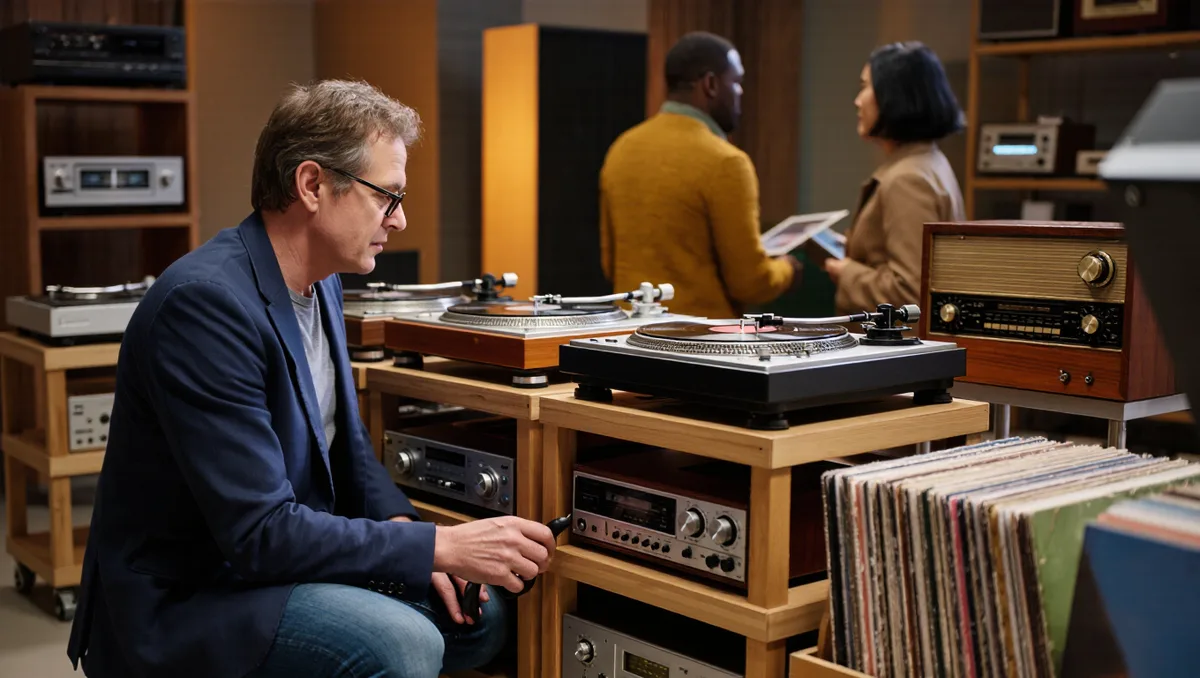
A good turntable at any price does three things: spins at a steady speed, tracks the groove without chewing it, and connects to something that makes sound. Everything else on the spec sheet is negotiable. The trick is knowing which extras actually change what you hear, and which ones exist to pad a listing. The short answer: at every budget, spend on the cartridge, the tonearm and speed stability first, and treat Bluetooth, USB and fancy plinth materials as conveniences, not upgrades.
That answer holds whether you have two hundred dollars or two thousand. What changes with budget is how much of the money goes to the parts that touch the record. Below is a budget-by-budget walkthrough, built on what the serious testing outfits actually measured and heard — including the reviewers at WIRED, whose guide to the best turntables has been updated repeatedly since 2020, and the Wirecutter team at the New York Times, which has tested more than 25 turntables and 20 all-in-one record players with both listening sessions and lab measurements.
What actually changes the sound of a record player?
Three parts do most of the work. The cartridge is the small unit at the end of the tonearm whose stylus reads the groove; better cartridges track more accurately and retrieve more detail. The tonearm holds the cartridge steady and applies the right downward force — the tracking force — so the stylus sits in the groove instead of bouncing out of it or digging into it. And speed stability matters because a platter that wavers in speed is audible as pitch wobble, technically called wow and flutter.
Wirecutter's testers ran objective measurements alongside listening — frequency response, distortion, speed variance, wow and flutter, and stereo balance — because, as they note, lab tests find flaws ears can miss. That is the right instinct for any buyer: the specs that matter are the ones you can hear, and speed accuracy tops that list.
What should you buy under $200?
Under $200, ease of use matters more than audiophile detail. The Audio-Technica AT-LP60XBT is the pick WIRED recommends for tight budgets: it is fully automatic, pairs with Bluetooth speakers, and includes a built-in phono preamp, the small amplifier that raises a turntable's signal so modern stereos and powered speakers can use it. WIRED notes that vintage receivers often had phono inputs built in, but most modern audio gear does not — so a built-in preamp is the single most practical feature at this price.
One honest caveat: Bluetooth digitizes the analog signal, and WIRED points out that anything sent wirelessly has been converted and may not sound its best. If you want the full analog chain, run a cable. We have looked at this price class in detail in our own Turntables under $200: an honest look at the class, and the same conclusion holds there — at this level, buy for reliability and correct setup, not for spec-sheet flourish.
What does $200 to $600 get you?
This is the sweet spot, where dedicated turntables stop being compromises. WIRED calls the Audio-Technica AT-LP120XUSB the most iconic entry-level turntable: it sounds good, is built durably, and can be upgraded with better components later. It also includes a phono preamp and a USB output for ripping records to files. In the same range, WIRED praises the Fluance RT81+ for its clarity and warmth, its isolation feet, and a counterweight mechanism that works better than most at the price; it ships with an Audio-Technica VM95E cartridge that can be swapped for upgraded models in the same line.
Wirecutter's own top pick in this class, the Fluance RT85N, is described as delivering accurate sound that works for any type of music, exceptionally well built for the price. And if you can stretch toward the top of the range, WIRED rates the Pro-Ject Debut Carbon Evo as the best sound for the money — a carbon-fiber tonearm, a damped metal platter, and a house-made cartridge that typically retails for $150 on its own. Its trade-offs are practical, not sonic: no auto-stop, and no built-in preamp, so you either buy an external one or need a stereo with a phono input.
What matters above $1,000?
At the high end, the spec sheet shifts from convenience to execution. Retailer World Wide Stereo's roundup of audiophile turntables for 2026 lists the McIntosh MT5 at $8,500 as its audiophile-grade pick: a belt-drive design with a vibration-dampening platter, a factory-fitted moving coil cartridge, and no Bluetooth, USB or built-in preamp at all. That absence is the tell. At this level, the money buys materials, motor quality and speed precision — not features. The MT5's selling point, per the retailer, is that it arrives calibrated and ready to perform with minimal adjustment.
Our analysis: above roughly a thousand dollars, ignore the feature list entirely and look at what the turntable is made of and how it is assembled. A plinth (the base) that resists vibration, a heavy platter, a well-machined bearing and a quality tonearm are what separate a $1,500 deck from a $500 one. A glowing logo does not.
Which specs are marketing fluff?
A few recurring suspects:
- Built-in speakers. Wirecutter separates all-in-one record players from dedicated turntables for a reason — its testers found that pairing a real turntable with a purpose-built speaker system sounds much better than any all-in-one they tested, at roughly three times the cost. A speaker in a turntable's base is a convenience, not a hi-fi feature.
- Bluetooth as a headline feature. Useful for casual listening, but it converts your analog signal to digital. If analog sound is why you bought vinyl, treat Bluetooth as a bonus, never the reason to choose one deck over another.
- USB outputs. Handy for archiving rare records, as WIRED notes about the AT-LP120XUSB, but the digitizer quality varies and it tells you nothing about playback fidelity.
- Exotic plinth finishes. Faux wood veneer and colorways sell units. Weight and rigidity matter; paint does not.
What is genuinely worth paying for at any tier: a replaceable, upgradeable cartridge; a proper counterweight and anti-skate adjustment rather than a fixed plastic arm; and a cue lever that lowers the stylus gently. Wirecutter explicitly valued speed switches, auto-stop and cue levers in its testing — small conveniences that protect your records every single day.
What this means for your first setup
Practical steps, in order. First, decide whether the turntable will connect to gear you own or need to drive speakers itself — that determines whether the built-in preamp is essential or optional. Second, budget for the rest of the chain: a turntable into poor speakers still sounds poor, and our guide to bookshelf speakers for small listening rooms covers the other half of the equation. Third, remember that the record itself is a component; our piece on how to judge vinyl pressing quality before you buy explains what to look for at the store, not after the needle drops.
Finally, if you already own a working turntable, Wirecutter's advice is worth repeating: you will likely get more from upgrading the phono cartridge than from buying a whole new turntable. The analog-versus-digital question — what each format actually changes — is one we take up separately in Digital versus analog listening: what changes and what doesn't. The evidence here is consistent: steady speed, good tracking and a decent cartridge are the specs that matter. Everything else is on the box to catch your eye.