Bookshelf speakers suit small listening rooms because a compact two-way design — one woofer, one tweeter, a cabinet small enough to keep away from walls — interacts less destructively with the standing waves and boundary reflections a small room creates. The room is not a neutral backdrop; below a few hundred hertz its dimensions reinforce and cancel particular bass notes, and the smaller the room, the higher that problem region climbs into the audible range. That documented acoustics, more than any brand characteristic, is why experienced listeners in apartments keep choosing small speakers.
AA Digital Sound publishes information, not purchasing advice; this is sourced analysis of how the speaker class works in real rooms, based on established acoustics and measurement practice.
What does a small room do to bass?
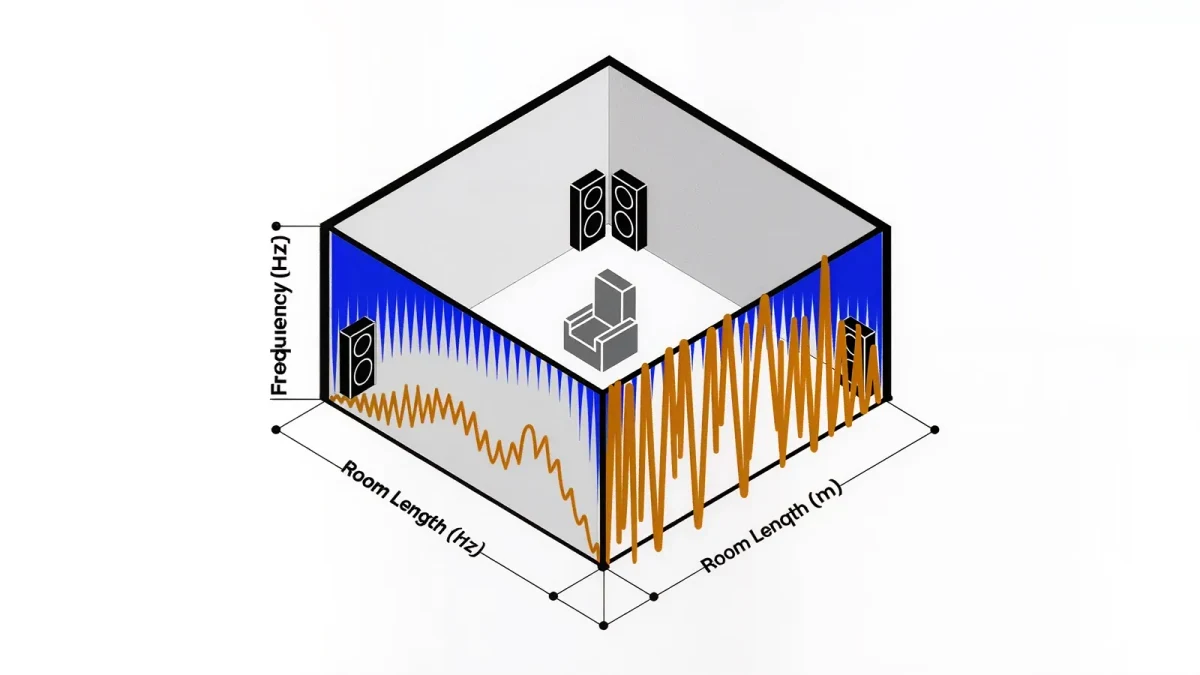
Room modes are the mechanism. Sound waves reflect between parallel surfaces, and at frequencies whose wavelength fits the room's dimensions, the reflections reinforce or cancel — so one seating position hears a note as bloated, another as missing. In a large room the lowest modes fall below the music's fundamental range; in a 3-by-4-meter room they sit squarely in the bass clef. No speaker escapes this: moving the speakers and the listening position changes which modes are excited, which is why acoustic texts treat placement as the first, free equalizer. A speaker with modest bass extension simply excites the worst modes less, which often sounds more accurate in a small space than a larger speaker working as designed.
Why do two-way designs dominate this class?
A two-way speaker crosses from one woofer to one tweeter around two to three kilohertz, a proven architecture that keeps the cabinet small, the driver count low, and the crossover — the circuit dividing frequencies between drivers — simple. Simplicity has a measurable benefit: every crossover point adds phase and directivity complications, and a modest two-way executed well measures more predictably than a complex design executed cheaply. The trade-off is documented too: a small woofer in a small cabinet reaches less low bass, typically rolling off somewhere in the 50–60 Hz region for this class, with the very lowest organ and synthesizer notes attenuated. In a small room, the boundary gain from nearby walls partially compensates.
How much does placement matter?
More than any upgrade cable ever sold. The documented rules are few and effective. Speakers close to the front wall gain bass reinforcement but risk boominess; pulled clear of the wall, imaging tightens. A roughly equilateral triangle between the two speakers and the listener, with the tweeters at ear height and angled slightly inward, aligns the drivers' arrival times. Symmetry matters: a speaker beside a window on one side and a bookshelf on the other measures unevenly. Even decoupling matters — a bookshelf speaker placed, as the name suggests, on a resonant shelf will excite that shelf; stands or dense pads address it. Each of these adjustments costs nothing and changes the measured response at the listening position by decibels.
Is near-field listening the small-room advantage?
Largely, yes. Sitting close to the speakers — the desk-style arrangement small rooms invite — raises the proportion of direct sound over reflected sound, which measurably improves clarity and stereo imaging even in untreated spaces. It is the same principle studio engineers use when they mix at short range. A small room that would fight a big speaker at the far end of a sofa becomes an asset when the listening triangle shrinks to a meter and a half: the speakers dominate, the walls matter less. Many listeners in apartments discover this by accident when the desk becomes the listening room.
Do you need a subwoofer?
Not necessarily — and in a small room, adding one can worsen the modal problem it is meant to solve, because a subwoofer excites room modes across the entire low end. When it works, it works because of placement flexibility: a subwoofer can sit where it drives the modes least badly, and its level can be set to blend below where the main speakers roll off. The honest test is documented music, not demonstration discs: sustained low organ pedal, walking bass lines, kick drum in a mix you know. If the bass notes sound evenly balanced walking around the room, the integration is right; if some notes vanish, the modes are winning.
What about the room itself?
Soft stuff is acoustic treatment that already exists in homes. Curtains, rugs, bookshelves with uneven spines, upholstered furniture — all absorb and scatter reflections, taming the flutter echo between bare parallel walls that makes small rooms sound glassy. Dedicated absorber panels target the first reflection points on the side walls; even a modest amount measurably improves clarity. The classic small-room compromise is treating the reflections while leaving enough liveliness that the space does not sound dead — a balance every serious listener iterates by ear with familiar recordings.
What is the realistic expectation?
A well-placed pair of modest bookshelf speakers in a treated small room, listened to at moderate levels, can deliver nearly everything a recording contains above the bottom octave — and can outperform far more expensive equipment placed carelessly. The class ceiling is honest: less deepest bass, less maximum volume than floor-standers, and a soundstage bounded by the room's width. But the small room that constrains the speakers also concentrates their virtues, which is why the pairing endures among listeners who care about accuracy first.