Cueing a record during a live show means finding the exact groove where sound begins, holding the record still against a moving platter, and releasing it at the right instant — a technique radio hosts have used since the 1940s, when transcription discs were the medium of broadcast. The method rests on a counterintuitive object: the slip mat, which lets the platter keep spinning beneath a stationary record so the DJ can stop, rock, and drop the music without losing time. It is a mechanical skill with its own vocabulary, its own failures — cue burn, the worn-sounding first seconds of a heavily cued record — and, on community and college stations, its own living tradition.
AA Digital Sound is a magazine about radio culture, and this primer describes the documented craft of vinyl playback from broadcast history — not a claim that anyone on our staff has spun a record on the air.
What are the actual steps of cueing a record?
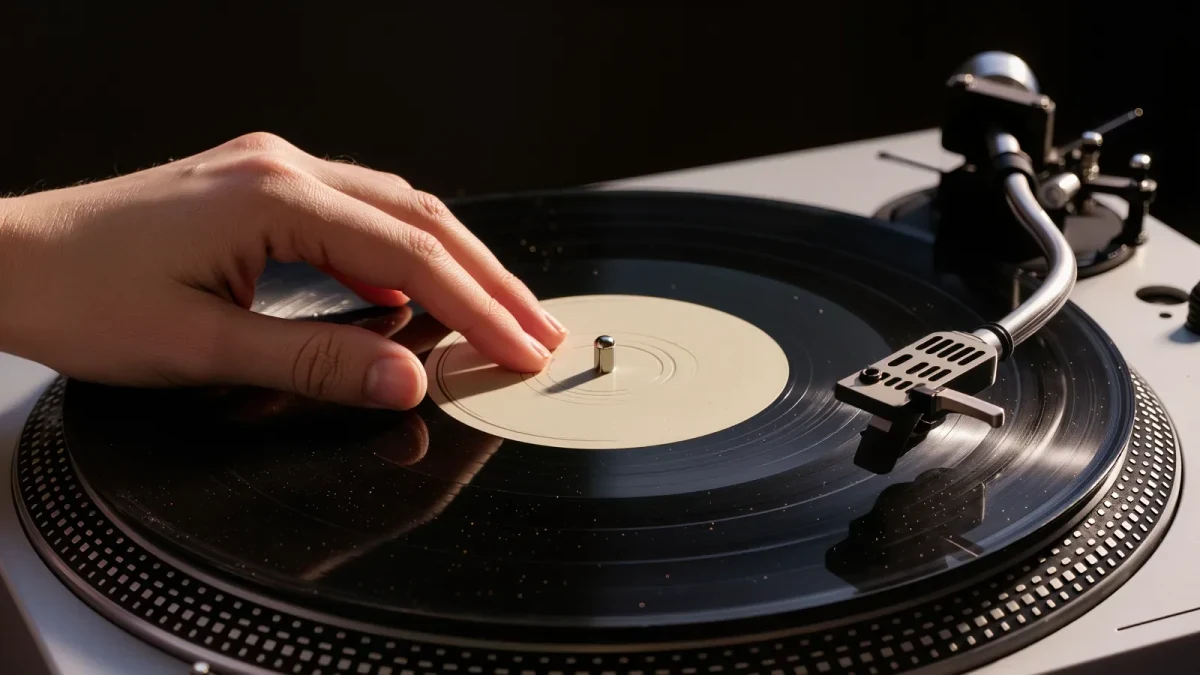
The broadcast procedure has been standard for decades. The DJ places the record on the platter over a slip mat, starts the turntable, and with the channel still off-air, drops the needle near the start of the track. Then the trick: the DJ stops the record with a finger on its label while the platter continues to spin underneath, rotates the record backward to just before the first sound, and rocks it gently forward until the very first downbeat sits under the stylus. When the moment comes, a release of the hand lets the spinning platter carry the record up to speed almost instantly, and the DJ opens the channel. Done well, the listener hears clean silence and then music, with no run-in noise and no stumble.
Why does radio cueing depend on the slip mat?
Physics. A turntable's platter has rotational inertia — it resists stopping — and a DJ who stops the record by stopping the platter must wait for the motor to bring it back to speed, which is fatal to live timing. The slip mat breaks the link: felt or other low-friction material between record and platter means the platter spins at a constant speed while the record above it can be held, dragged backward, or nudged forward. Direct-drive turntables, introduced in the early 1970s — Technics's SL-1200, launched in 1972, became the standard — made this practical by keeping speed stable under hand pressure. The same mechanism that lets a club DJ scratch, a technique attributed to Bronx innovators in the mid-1970s, is what lets a radio host park a record silently at its first beat.
What is cue burn, and why do radio copies of records sound worn?
Cue burn is the audible cost of back-cueing. When a DJ drags a record backward under a tracking stylus, the groove walls in those first few seconds are abraded again and again — repeated cueing rounds the sharp transient that begins the track, leaving a soft rush or distorted attack before the music stabilizes. Records cued hundreds of times in station libraries were known to staff by it. Programmers developed habits around the problem: cueing to a count from the run-in rather than the very first groove, using duplicate copies for heavy rotation, and reserving the cleanest pressing for air while promo copies took the wear. Collectors of vintage radio-library vinyl still encounter cue burn as evidence of a record's broadcast life.
How do live vinyl sets on community radio actually run?
On freeform and community stations, a vinyl-based show is a small logistics operation. The host arrives with crates selected in advance, checks discs for cleanliness and warps, and plans rough sequence — long album sides buy time to cue the next record, which is one reason vinyl hosts favor extended tracks. During a live show, the work is continuous: cue the next record during the current one, set levels by ear, watch the clock for station IDs, and keep a hand free for the fader. Mistakes are part of the aesthetic; a slightly late drop or an audible run-in reads as liveness rather than failure, and many hosts prefer it to the frictionless feel of digital playback. The Library of Congress's recorded-sound collections, which preserve everything from early broadcast transcriptions to DJ-culture artifacts, document how long this continuity of craft runs.
Why do hosts still play vinyl when digital playback exists?
The honest reasons are practical and cultural at once. Practically, a cued record is a physical commitment — the host touched it, timed it, and is now responsible for it — which produces a different attention than clicking a file. Culturally, vinyl carries the station's identity: community and college stations accumulated libraries over decades, and playing them keeps the archive alive rather than warehoused. There is also a sonic argument hosts make, though it belongs to them rather than to this magazine: the slight surface noise and the mechanical reality of the medium sit well with freeform programming's ethos. None of this is nostalgia alone — vinyl sales grew for years into the 2020s, and broadcast-adjacent turntables remain in production precisely because stations kept ordering them.
What does it take to learn the technique?
Patience, a slip mat, and a stylus you can afford to wear. The fundamentals — back-cueing to a beat, dropping on time, riding levels — can be practiced off air in an afternoon, and station training at community outlets has taught generations of volunteers exactly that way. Fluency takes longer: the hands learn where a record's first sound lives, how far to rock, and when to stop checking the clock and trust the count. It is one of radio's oldest physical skills, and at the stations that still keep crates by the console, it is still being learned by hand.