College radio still breaks new artists first because it is the one corner of the dial where nobody has to answer to a ratings chart. Student programmers choose their own music, often with no playlist supervisor at all, and the FCC has reserved the noncommercial portion of the FM band — 88.1 through 91.9 MHz — for educational stations since the 1940s. That combination of freedom and low stakes is why bands from R.E.M. in the early 1980s to Arcade Fire in 2004 built their first national momentum on campus frequencies before commercial radio noticed them.
AA Digital Sound is an online magazine about radio culture, not a broadcaster, and this piece is a sourced primer rather than a promotional pitch for any station or format.
What makes a college station different from a commercial one?
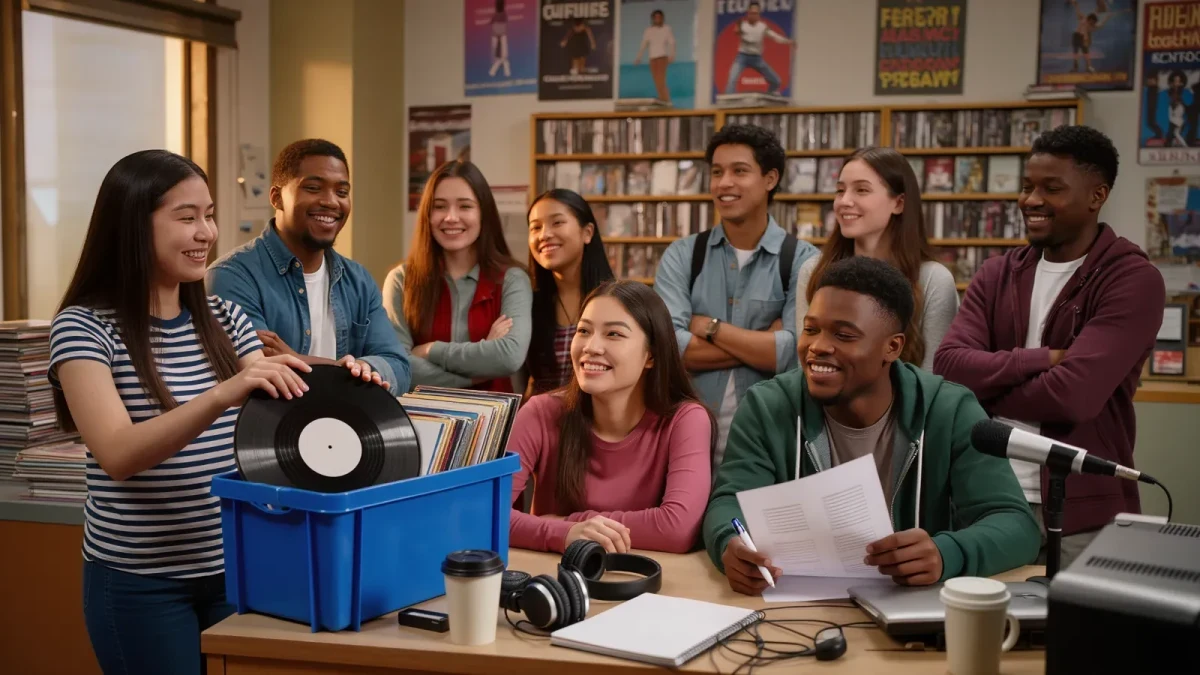
The differences are structural, not just tonal. Most college stations hold noncommercial educational licenses, which means they cannot sell traditional spot advertising; they survive on student fees, listener donations, and underwriting credits with strict FCC limits on what those credits may say. A commercial music director, by contrast, answers to advertisers who want the largest possible audience, which pushes programming toward familiar hits. Campus programmers usually answer to nobody but their own taste, and many stations run a freeform or block format in which each host programs an hour alone.
That structure produces a specific on-air culture: long album tracks, local bands, genre niches, and hosts who talk about music they discovered that week. The educational mission is part of the license itself — the station exists partly to train students in broadcasting, so experimentation is the point rather than a risk.
How does a song get added to college radio rotation?
The path is shorter than anywhere else in the industry. A label or a self-released artist mails or uploads tracks to a station's music director, who either adds the record to a general rotation or passes it to individual show hosts. Since the late 1970s, the trade publication College Media Journal — CMJ, founded in 1978 — aggregated weekly charts from hundreds of campus stations, giving labels a single number that measured early buzz. Even after CMJ's print era faded, the underlying pipeline stayed: adds at college radio, then specialty-chart attention, then commercial and streaming pickup.
For an unknown band, the costs are low and the feedback is honest. A single add at a well-followed station can start a chain, because music directors at campus stations read each other's charts and trade tips the way record clerks once did.
Which artists got their start this way?
The historical record is long enough to feel like a pattern rather than luck. R.E.M.'s earliest singles traveled from Athens, Georgia campus and community stations to national attention in the early 1980s. Nirvana's 1991 album Nevermind spent months building at college and modern-rock stations before it reached the top of the Billboard chart that winter. Arcade Fire's 2004 debut Funeral was propelled by campus-radio airplay and word of mouth into a Sub Pop-and-beyond career. More recently, artists across indie, hip-hop, metal, and electronic music have used the same route: a campus add campaign is still one of the first line items in an independent label's release plan.
What links these stories is not a specific sound but a specific audience. College listeners are unusually willing to hear something unfamiliar at 11 p.m. on a Tuesday, and programmers are unusually willing to play it for them.
Does college radio still matter in the streaming era?
Streaming made music easier to hear and harder to notice. Playlists answer algorithms, and algorithms answer yesterday's behavior, which favors songs that are already popular. Campus radio runs the other way: a human being chose the song, and a human being will tell you why before it plays. For artists, that means a college add still generates something a stream count cannot — a named advocate, a chart position that label staff actually read, and a first press mention when a station charts a record.
Streaming did shrink the gatekeeping power of any single station, and many campus outlets now stream their signal and archive shows as podcasts, extending reach far past their transmitter's range. But the core function has not moved: college radio remains a low-cost, human-filtered discovery layer sitting underneath an algorithmic one.
How can a new artist actually use college radio?
The practical playbook has been stable for decades. Prepare a clean submission — high-quality audio, a one-sheet with tour dates and contact information, and a clear genre description so the music director can route it to the right shows. Send it to stations whose format genuinely fits, because a mismatched submission is discarded. Follow up politely, and treat specialty shows — the late-night genre blocks — as the most realistic first adds. Chart reporting, where a station still files it, turns those adds into a signal the rest of the industry can see.
None of this guarantees anything, and honest coverage of the college-radio route should say so: most submissions go nowhere. But the route remains open to artists with no budget beyond postage, which no other broadcast platform can claim.
What is being lost when a campus station goes dark?
When a university sells a license — a trend that has accelerated as FM frequencies became valuable real estate — the loss is not just a student activity. It is a local music institution, a training ground for broadcasters and engineers, and one more slot of noncommercial bandwidth converted to commercial or religious network programming. Radio historians and listener groups have documented license sales across the country for decades, and each one removes a piece of the infrastructure that this article describes. What remains is still substantial: hundreds of student-run and community-run educational stations, most of them streaming now, still programming by hand.
The economics of radio continue to shift, but the case for campus frequencies has stayed remarkably consistent since the FM band was parceled out — somewhere on the dial, someone should be free to play the unfamiliar.