Community radio stations fund themselves through listener donations, underwriting credits, grants, and parent-organization support, because their licenses forbid selling advertising at all. Noncommercial educational stations in the United States — community, college, and public outlets alike — operate under FCC rules that permit only value-neutral underwriting acknowledgments, and many fill two-thirds or more of their budgets from pledge drives and individual giving. The model has been running since the 1940s, when the first noncommercial FM licenses were issued, and it remains the financial backbone of hundreds of local stations.
AA Digital Sound is an independent magazine about radio culture; this primer explains the documented economics of noncommercial radio, not a solicitation of any kind.
What is underwriting, and how is it different from advertising?
Underwriting is a paid acknowledgment, not a commercial. FCC rules for noncommercial stations restrict the content of underwriting credits to identification — the funder's name, location, and a neutral description of goods or services — with no calls to action, no price information, and no inducements to buy. A public station may thank a bakery for its support and say where it is; it may not say the bakery's croissants are on sale Friday. The distinction is older than most listeners realize: it descends from the rules that governed sponsored radio's earliest decades, when even commercial networks announced program sponsors rather than selling spots. For community stations, underwriting from local businesses — a few hundred dollars a month for a rotating credit — is often the single largest predictable revenue line.
Why do pledge drives take over the schedule several times a year?
Because they work, and because stations can compute exactly how well. A pledge drive suspends normal programming for a defined period — typically a week or ten days, once or twice a year — while hosts make the case for listener support, set dollar goals, and offer thank-you gifts: tote bags, vinyl pressings, premium access to archives. The psychology is direct: a listener who hears a volunteer explain what the station's budget actually is, and what it buys, converts at a far higher rate than one who never hears the ask. Drives are scheduled around listening peaks, planned like military operations — goal tracking, pitch training, premium fulfillment — and, at stations with stable budgets, increasingly supplemented by year-round online giving so the drives can shorten.
Where does the rest of the money come from?
A typical noncommercial station blends four or five streams. Individual giving, both during drives and through sustained monthly contributions, is usually the base. Underwriting sits on top. Grants — from community foundations, state arts councils, and in public media the Corporation for Public Broadcasting, which Congress created in 1967 to funnel federal support to noncommercial broadcasting — arrive in cycles and fund equipment, reporting projects, and staff. Parent organizations contribute: a college station's budget may be a line in a student-activities fund, and a community station may receive in-kind support from a school district or tribal government. Finally, everything else is volunteer labor, which is not a revenue line but is the reason the revenue suffices — a station with thirty volunteer programmers has shifted most of its staffing cost outside the budget entirely.
What does a community station's budget actually look like?
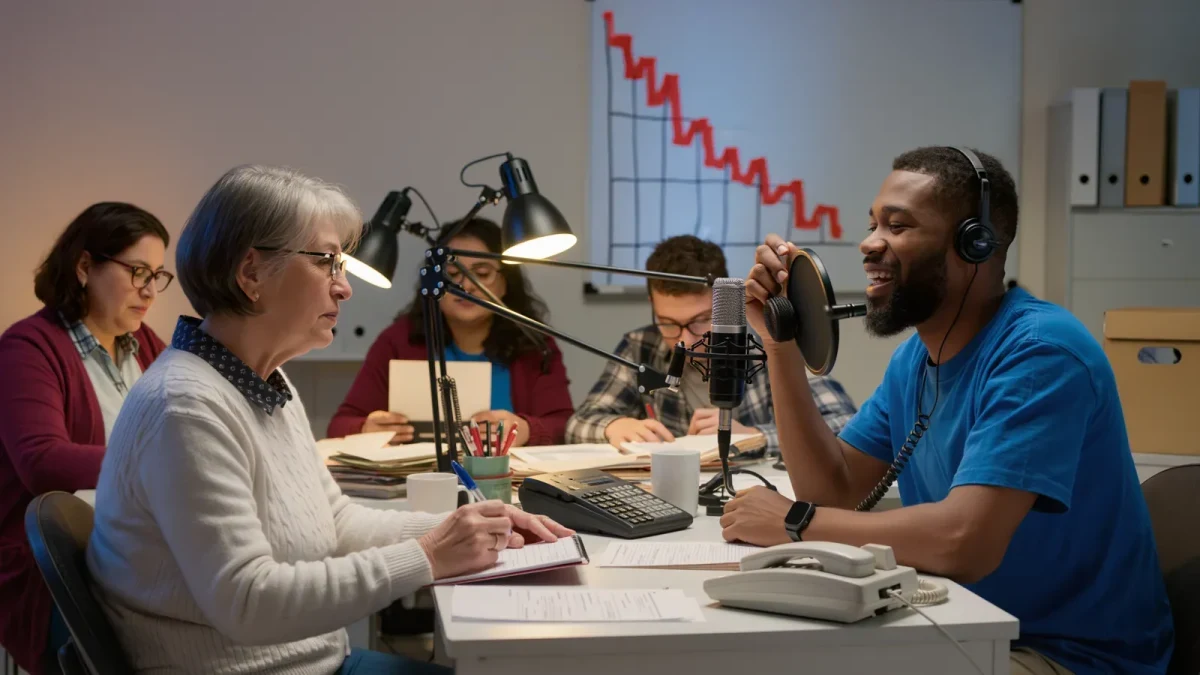
Small and legible. An LPFM or small community FM station can operate on a modest five-figure annual budget: transmitter site rent or tower lease, streaming costs, music-licensing royalties — noncommercial stations pay reduced statutory rates for their streams — insurance, phone lines, and studio upkeep. Equipment is frequently donated or bought used from stations upgrading. A mid-size community station with a small paid staff runs on a budget an order of magnitude larger, but the structure is the same: no single stream is safe, so every plan is a mix. When one stream wobbles — a grant cycle ends, a major underwriter closes — the station's response is almost always the same: go back to the listeners.
What happens when the money runs short?
The documented pattern is a spiral of last resorts: deferred equipment repairs, shorter drives, emergency appeals, and in the hardest cases license sales. Community radio history includes stations saved by an anonymous donor in the final week of a drive and stations that went dark despite packed volunteer rosters, and the difference is usually whether the station built sustained monthly giving before the crisis. Groups that support community stations — including the advocacy organizations that pushed for the Local Community Radio Act of 2010 — treat financial resilience as an organizing skill, teaching boards to budget for royalty increases and transmitter failures years in advance.
Why do listeners give at all?
Because the station gives them something the commercial dial does not. Research and decades of pledge-drive practice point to the same motivations: the station reflects the listener's community or language, it plays music found nowhere else locally, it carried the emergency information when nothing else did, and it is run by people the listener has met. Noncommercial radio's founding bargain — the station belongs to its community rather than to advertisers — turns out to be a fundraising strategy as much as a philosophy. Listeners donate to keep something they already use, and the drive is simply the station asking out loud.