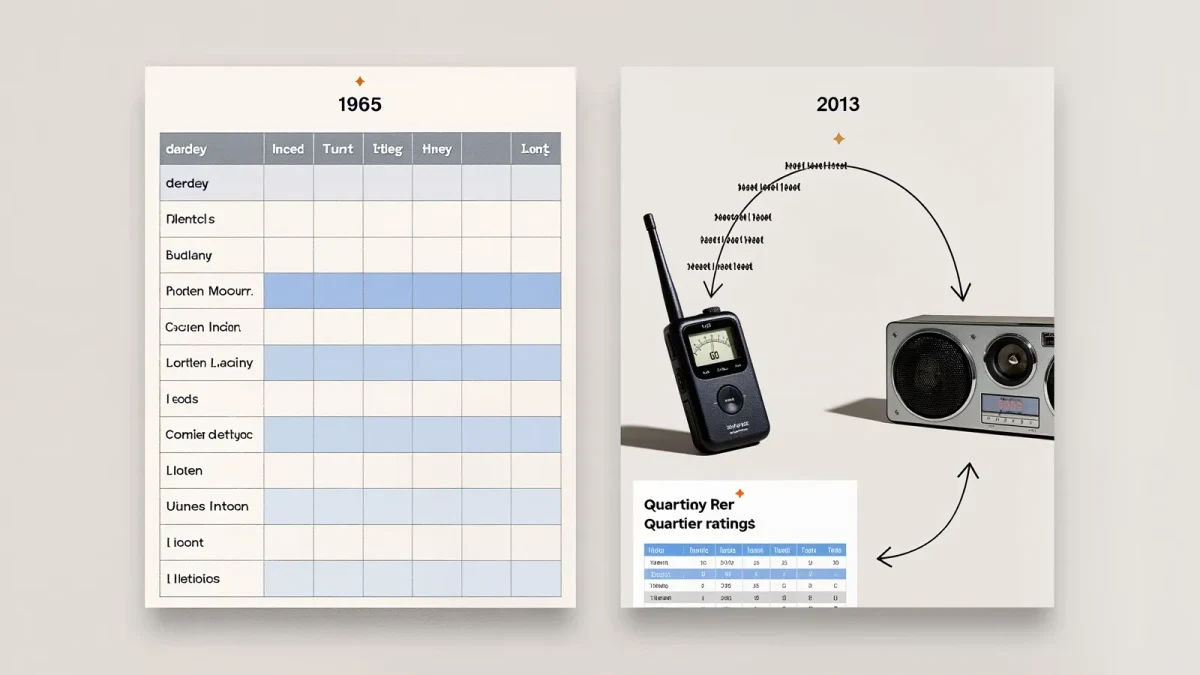
Radio audience measurement in the United States works through two main methods: the diary, in which sampled listeners write down everything they hear for a week, and the portable people meter, a passive device that automatically detects inaudible codes embedded in broadcasts. Both are conducted by Nielsen, which bought the radio-ratings firm Arbitron in 2013 and folds radio into the same quarterly-survey machinery that measures television. The results — estimates of who listened, to what, for how long — set advertising rates across the industry, which means the whole sound of commercial radio rests on the methodology described below.
AA Digital Sound is a magazine about radio culture; this primer explains the documented measurement system and its limits, with figures attributed to their industry and historical sources.
Where did radio ratings come from?
The methodology descends from mid-century survey research. Radio's dominant ratings firm for decades was Arbitron, whose name came from its founding era of arbitron-style audience measurement; its diary-based radio survey became the U.S. standard in 1965, when the company standardized the seven-day listening diary. Competitors and predecessors used telephone recall — calling households and asking what stations they remembered hearing — and the famous Hooperatings of the 1930s and 1940s, which popularized the phrase error-prone researchers still argue about: the percentage of households listening, coincidental to the call. The measurement industry consolidated over the decades, and Arbitron's 2013 acquisition by Nielsen for about $1.3 billion put radio ratings inside the largest media-measurement company in the country.
How does the diary system work?
A station's diary week begins with recruitment: measurement firms sample households within a market, invite them to participate, and mail paper or digital diaries in which each person records, for one week, every fifteen minutes of listening — station, time, and place. Diaries reward memory and conscientiousness, which is precisely their weakness: respondents round, forget, and write down the station they think they should report, biases well documented in the survey-research literature. Diaries tend to overstate morning listening and favor stations with distinctive brands, because a diary entry depends on the listener remembering and correctly identifying a station. Even so, diaries remain the measurement method for most small and mid-size markets, where meter panels would be impractical, and station staff still celebrate — or dissect — quarterly diary results with the intensity the numbers' commercial consequences justify.
How does the portable people meter work?
The meter is a small pager-like device, and it listens so the panelist does not have to. Participating listeners carry it through the day; stations in the market embed an inaudible identification code in their audio, and the meter logs every code it hears, along with the time. Panelists dock the device nightly to upload data. The method removes the memory problem entirely — a meter captures exposure the panelist has already forgotten — and shows, famously, different behavior than diaries did: more brief tuning, less brand loyalty, and a stronger position for news and talk formats whose hosts prompt long, habitual listening. Nielsen rolled the meter out across major U.S. markets in the late 2000s, and markets that switched saw station rankings shuffle accordingly, a transition covered extensively in the trade press of the period.
What do stations actually do with the numbers?
Read them like X-rays. The quarterly reports — surveys that in most markets run in monthly or quarterly phases — break the audience down by age, sex, daypart, and listening location, and every programming decision leans on them: which morning show survives, whether a format flips, which hours a host gets coached on. Advertisers buy against the demographic estimates; a station that measures strongly with a desirable audience in drive time can charge multiples of what a weaker signal charges for the same minutes. Noncommercial stations use ratings too, more softly — for underwriting pitches, programming review, and, in public media, audience reporting to funders. Where measurement does not reach — most community and LPFM stations are not rated at all — stations use their own tools: listener surveys, stream analytics, pledge-drive response, and plain counts of who shows up to events.
What are the known weaknesses?
Sampling, response, and identity. Ratings are estimates from small panels in large markets, with margins of error that can exceed the gap between two competing stations. Recruitment is hard: persuading a representative sample of a metro area to carry a meter or fill a diary is an ongoing challenge for survey firms, and panel composition skews toward the cooperative. Identification can fail — a diary entry names the wrong station; a meter hears audio from a speaker in a passing car. And streaming complicates everything, because a station's online audience is counted in a separate digital ecosystem rather than in its broadcast ratings. The measurement industry has spent years converging the two, and broadcasters now quote combined figures — broadcast plus digital — when the combination flatters them.
Why should a listener care how listening is counted?
Because the measurement system quietly shapes the dial. What gets counted gets funded: formats that measure well under meters — spoken word, in particular — expanded after the meter era began, and formats that depended on diary goodwill lost ground. The quirks of the method are not abstract; they are why one host gets a contract extension and another gets a format flip. For the noncommercial and community stations this magazine follows, the deeper point is simpler: the stations that matter most to discovery culture are usually the ones no ratings panel will ever capture, measured instead in phone calls, letters, and decades of volunteers.