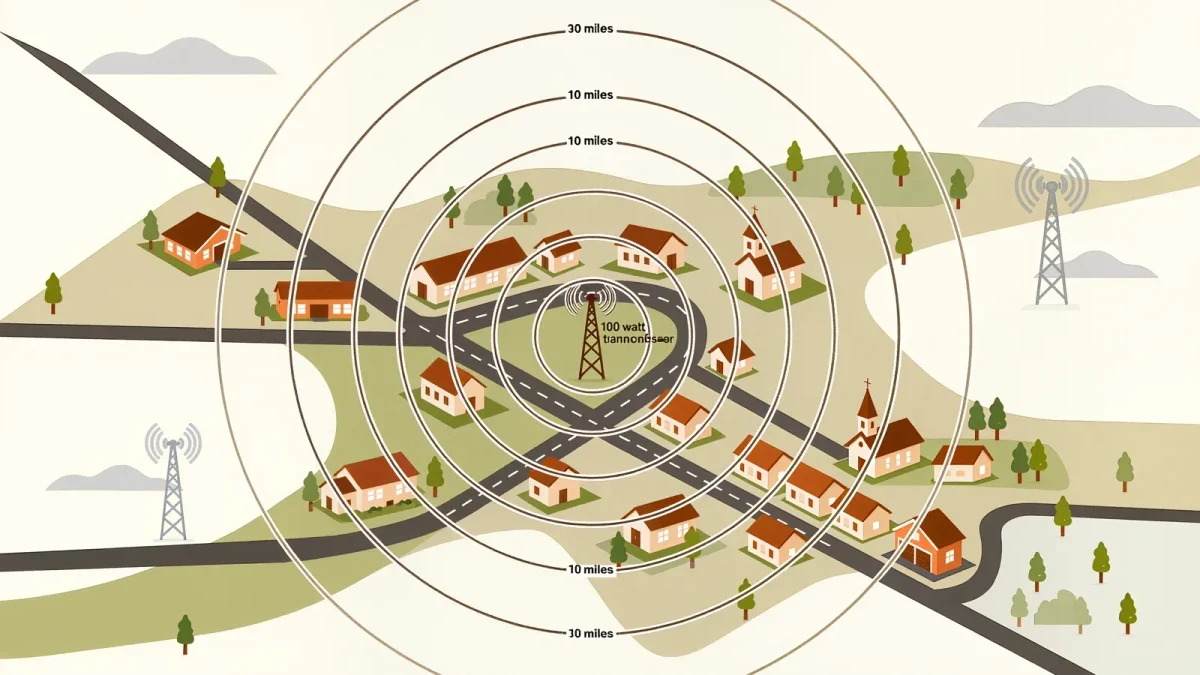
Low-power FM — LPFM — is a class of noncommercial community radio station created by the FCC in January 2000, licensed to schools, churches, tribes, and local nonprofits at 100 watts or less, with a signal radius of roughly three to ten miles. There are on the order of two thousand licensed LPFM stations across the United States, and most of them sit in small towns and rural counties where commercial consolidation has emptied out the local dial. They broadcast school closings, high-school games, obituaries, and the music their communities actually listen to — the raw material of local identity.
AA Digital Sound is an independent magazine about radio culture; this primer explains how the LPFM service works and why it exists, based on FCC program rules and documented station history.
What exactly is an LPFM license?
An LPFM station is a full-power FM license in miniature, with rules written for community scale. Eligible license holders must be educational nonprofits or governmental entities — a tribe, a school district, a community organization — not individuals or commercial companies. Transmitters run between 1 and 100 watts, which is tiny beside a 50,000-watt commercial signal, and the license is noncommercial: no advertising, only the restrained underwriting credits the FCC permits on educational stations. Each license is local by construction. The FCC gives preference to applicants proposing local program origination, and the service's rules were designed so a church basement or a school portable can host a station that genuinely belongs to its town.
Because the signals are small, LPFM slots could be squeezed into gaps on the FM dial that full-power stations left unused — including in suburbs and smaller cities, not only remote areas.
Why did the FCC create the LPFM service?
The service was a deliberate answer to consolidation. After the Telecommunications Act of 1996 relaxed ownership caps, thousands of commercial stations changed hands, and groups of stations under one owner meant fewer local voices per market. Community advocates argued that low-power licenses could put broadcasting back within reach of small organizations. The FCC established the LPFM service in January 2000, but Congress initially forced spacing rules so strict that most urban licenses were impossible — until the Local Community Radio Act of 2010 directed the FCC to relax third-adjacent-channel protections and open the service to more cities. A major licensing window followed in 2013, and another in 2023, each adding hundreds of new community stations to the dial.
That legislative back-and-forth is why LPFM looks the way it does: a patchwork of small signals, dense in some regions, sparse where the dial is already full.
What do LPFM stations actually broadcast?
Mostly the things a town cannot get anywhere else. Documented LPFM programming includes local news bulletins and public-affairs shows produced by volunteers, high-school sports and school-board meetings, emergency information during storms and wildfires, and music shows that reflect the actual makeup of the community — Spanish-language programming on stations serving agricultural valleys, Indigenous-language shows on tribal stations, gospel, polka, regional Mexican genres, and local bands. Many LPFM stations stream their signals online as well, which lets a diaspora listen from far away. The common thread is that programming decisions are made within a few miles of the transmitter, by people who shop at the same stores as their listeners.
How does a 100-watt station survive economically?
Cheaply, and by design. An LPFM transmitter, antenna, and basic studio can be set up for a sum in the low tens of thousands of dollars — sometimes far less with donated equipment — compared to the cost of building a full-power commercial outlet. Operating costs are modest: studio space, streaming, music-licensing royalties, and volunteer labor. Stations fund themselves through parent-organization budgets, listener donations, small grants, and underwriting from local businesses within the FCC's limits. The economics work precisely because expectations are local: a station that measures success by whether it announced the snow-day closing first can run on a shoeline budget indefinitely.
What are the limits of low-power radio?
The signal is the obvious one. A 100-watt FM transmitter can be washed out by terrain, pushed around by atmospheric conditions, and simply inaudible a county away. Spectrum is the other constraint: LPFM stations must fit into second-adjacent channels around existing signals, which has kept the service out of some crowded urban markets. There are also practical pressures — a volunteer station is one departed volunteer away from silence, and each FCC filing window brings competition for the few remaining frequencies. None of this has stopped the service from growing licensing window by licensing window.
How do communities start one?
The route runs through the FCC's LPFM application process. A qualifying organization waits for a filing window, secures an available frequency through a study of the local dial, prepares an engineering statement, and applies through the commission's Licensing and Management System — the FCC maintains a dedicated LPFM page with the service's rules and filing guidance. Construction permits then require the station to build and begin operations within a set period. Community radio advocacy groups, some operating since the 1990s, help applicants with engineering and paperwork, and much of the service's growth has come from their workshops.
For towns that lost their local station to consolidation decades ago, that paperwork is the beginning of getting a voice back.