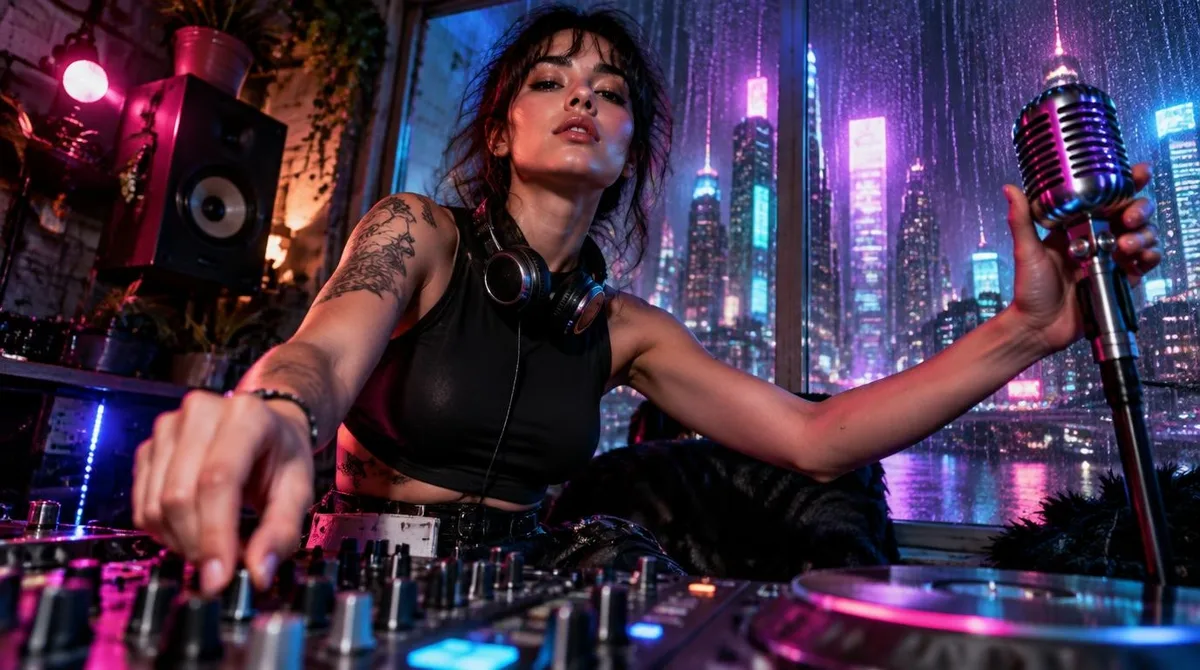
Cyberpunk radio stations are music streams built around the sound and mood of the cyberpunk genre — dark electronic music, synthwave, dystopian soundscapes and radio drama set in imagined futures. Most of the famous ones live inside video games, where they work as fictional stations on an in-game dial. Outside the games, a loose network of fan-run internet streams carries the same aesthetic, and finding them is mostly a matter of knowing the genre tags to search.
The genre itself has deep roots. According to Wikipedia's overview of cyberpunk, the term blends "punk attitudes and high technology", and the fiction it names is defined by "lowlife and high tech" — artificial intelligence and body modification set against societal decay. That tension is exactly what the music reaches for: shiny synthesizer surfaces over something rotten underneath.
This guide walks through what these stations play, where the best-documented ones live, and how to find streams that match the mood. If you want the wider context of how unusual stations fit into listening habits, our radio coverage tracks the whole field, and our discovery section follows the ways listeners find music that algorithms miss. For related coverage, see How to Find New Music: The Best Ways to Find New Music Without an Algorithm.
What makes music sound cyberpunk?
The sound leans on a small, recognisable toolkit. Analog-style synthesizers carry the melody. Drum machines keep things cold and mechanical. Reverb sits heavy in the mix, so everything feels like it is playing in a vast, half-empty space. The result is music that sounds futuristic and decayed at the same time — neon signs flickering over wet concrete.
Synthwave is the genre most people mean when they talk about cyberpunk music. It is a modern style built on the sounds of 1980s film scores, and it borrows the imagery of that era's science fiction directly. Darksynth, a heavier and more aggressive offshoot, pushes the tempo and the menace. Ambient and drone material covers the quieter end — the sound of a city humming at three in the morning.
That quieter end overlaps with other listening. If you find yourself drawn to the slow, textural material more than the beats, our guide to what makes ambient music ambient explains how that style works on the listener. The two tastes share more than you might expect.
Where are the best-known cyberpunk radio stations?
Inside video games, oddly enough. The most famous fictional stations live on the dial of Cyberpunk 2077, the 2020 role-playing game set in the fictional Night City. The game treats radio the way a real car does: you get in, you turn the dial, and the city talks back to you through fictional DJs, fake adverts and a full music rotation.
The station roster keeps growing. As Beebom reports, the game's update 2.5, released in October 2026, added a station called HKGN 102.0 FM, which plays music from the Cyberpunk: Edgerunners anime series. The station needs no quest or unlock — you simply select it through the game's Radioport menu or the radio in your character's apartment, and it plays roughly sixteen tracks drawn from both Edgerunners seasons.
That tracklist is a decent primer in the modern cyberpunk sound all by itself. Beebom's player-reported list runs from Rico Nasty's "You Can't Run From Me" to several cuts credited to KIRA VOID, plus material from Tsuneo Imahori and Akira Yamaoka — a composer better known for his work on horror game soundtracks. It is a mix of rap, industrial electronics and score-style atmosphere, which is roughly the genre's whole range in one station.
How do you find cyberpunk streams outside of games?
Real-world cyberpunk radio is mostly internet radio, and the way in is the genre tag. Directory services and streaming apps let you search by style, so terms like "synthwave", "darksynth", "retrowave" and "dystopian ambient" will surface dedicated 24-hour streams. Many are one-person operations: a curator, a server and a rotation of tracks licensed for streaming.
A few practical steps will save you time:
- Search an internet radio directory for the genre tags above rather than the word "cyberpunk" alone — the tags are what curators actually use.
- Check whether a stream publishes a tracklist. Curators who name every track are the ones worth following, because the stream becomes a discovery tool rather than background noise.
- Sample at different hours. Some stations shift mood across the day, from beat-driven programming to late-night ambient blocks.
- Follow the thread to the source. When a stream plays something you like, look up the artist and the label — the scene is small enough that one good find leads to a dozen.
That last habit matters more here than in almost any other genre. Because much of this music comes from small labels and self-releasing artists, the streams function like the specialist shows and shops that have always broken new scenes. Our piece on how record stores still drive music discovery makes the same point about physical shops; the mechanism is identical, just wearing a different coat.
Why does a fictional genre need its own radio?
Our analysis: the cyberpunk station is doing something radio has always done, just with the fiction turned up. A station is a world with a voice on it — a DJ, a schedule, a set of shared references. Cyberpunk fiction is obsessed with media systems and who controls them, so building fully realised fictional stations inside games is the genre writing itself into the medium it always wrote about.
There is a practical payoff for listeners, too. A curated stream with a consistent mood solves a problem playlists rarely do: it holds an atmosphere for hours. That is the same appeal our guide to finding new music without an algorithm describes — a human or a well-built rotation making choices with intent, rather than a feed reacting to your last click.
The genre's history explains the reach. Wikipedia traces cyberpunk from the New Wave science fiction of the 1960s and '70s through William Gibson's 1984 novel Neuromancer, and notes that the term was popularised in part by editor Gardner Dozois, including in a 1984 Washington Post article. Films like Blade Runner (1982) gave the aesthetic its visual language, and that visual language is what the music's cover art, logos and station idents still borrow today.
Where should a new listener start?
Start with the game stations if you own the games — they are the most fully produced examples of the form, and the Edgerunners station is a strong single-session survey of the current sound. Then move outward: one synthwave stream for the driving music, one ambient stream for the late hours. Keep notes on what you hear, because the scene's artists move fast and the names blur together quickly.
The honest limit of this world is that much of it is mood first, songcraft second. Some nights that is exactly what you want. On the nights it is not, the same streams will hand you back to the wider electronic scene, and the discovery continues from there. The dial, fictional or not, still does what radio has always done: it keeps playing until something stops you.