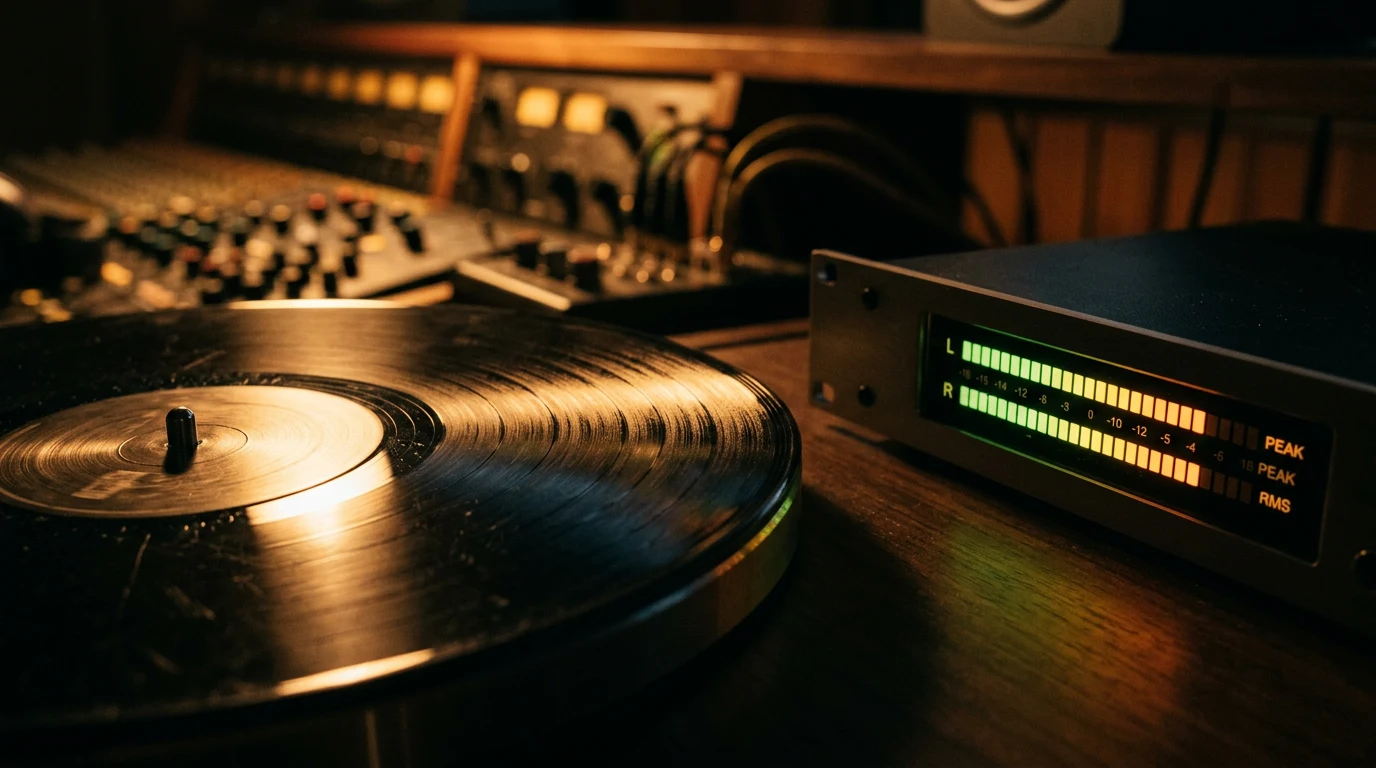
Loudness normalization is the playback rule that turns a track down — or up — to a common reference level before it reaches your ears, which is why a heavily squashed single no longer leaps out ahead of a quieter one. Spotify's published guidance puts its reference at −14 LUFS; European broadcasters work to −23 LUFS. The record itself is untouched.
That single mechanism has quietly rewritten the economics of making music loud. For four decades, mastering louder was a competitive move; since the streaming services and broadcasters adopted measured targets, it mostly is not. Understanding how the measurement works is the difference between hearing a mix and hearing a marketing decision.
What is loudness normalization, exactly?
Loudness normalization is a playback process that measures the average perceived loudness of a whole programme or track and applies a single gain offset so everything lands near an agreed reference. It is not compression and it is not limiting: nothing inside the recording is reshaped, and the dynamic distance between the quiet passages and the loud ones survives intact.
The unit is LUFS — Loudness Units relative to Full Scale. One LU equals one decibel, and the whole scale runs below zero, so −23 LUFS is considerably quieter than −14 LUFS. Spotify describes the adjustment as applied during playback without permanently altering the uploaded file, and offers listeners three settings — Loud at −11 LUFS, Normal at −14, Quiet at −19.
The practical consequence is blunt. If a master is pushed hard to sit at −7 LUFS, normalization simply turns it down by several decibels to meet the reference. What the listener keeps is the flattened dynamic range that the loudness push cost — without the loudness that was supposed to be its payoff.
How do the standards actually measure loudness?
Every target in use traces back to one document: Recommendation ITU-R BS.1770, titled "Algorithms to measure audio programme loudness and true-peak audio level," now in its fifth revision, dated November 2023 and listed by the ITU as in force. It defines both the loudness algorithm and the true-peak measurement that sits alongside it.
BS.1770 does not measure raw signal level. It applies a frequency weighting that approximates the ear's sensitivity, then discards the near-silent stretches through a level gate so that a passage of room tone cannot drag a programme's measured loudness downward. The result is a number that tracks how loud something seems rather than how big its waveform is.
The EBU's R 128 recommendation, in its November 2023 fifth version, builds the broadcast rulebook on top of that algorithm. It requires programme loudness normalized to a target of −23.0 LUFS, permits a tolerance of ±1.0 LU where the exact target is impractical — live programming, for instance — and allows only ±0.2 LU in quality-control workflows, to account for measurement error.
R 128 also caps the other end. True peak level, the document specifies, "shall not exceed −1 dBTP" during production, with a ±0.3 dB measurement tolerance for signals limited to 20 kHz. That ceiling exists because digital-to-analog conversion and lossy encoding can both produce peaks higher than any sample in the file.
Why did records get louder in the first place?
Because loud stood out, and standing out was the point. The mastering engineer Bob Ludwig, speaking to NPR in a report published on December 31, 2009, traced the escalation to the singles era: when he entered the business, he said, "one producer after another just wanted to have his 45 sound louder than the next guy's" to cut through on radio playlists.
The tool was dynamic compression. Ludwig described compressors as squashing music, "making the quiet parts louder and the loud parts a little quieter, so it jumps out of your radio or iPod" — and described the cost in terms of transients, saying a heavily processed snare "really no longer sounds like a snare drum with a very sharp attack" but instead like "somebody padding on a piece of leather."
He also named a listener-side consequence that fed the backlash: "When you're through listening to a whole album of this highly compressed music, your ear is fatigued." In that same 2009 NPR report, the University of Minnesota auditory-perception researcher Andrew Oxenham addressed a separate confusion, explaining that data compression in higher-bitrate MP3s is, in his assessment, basically indistinguishable from CD — a different phenomenon entirely from the dynamic compression Ludwig was describing.
What targets do platforms and stations actually use?
There is no single number, and that is the first thing to understand about the current landscape. Broadcast sits lowest, streaming music sits highest, and spoken-word delivery lands in between. Each figure below comes from the organization that set it or from a named report on it.
| Context | Reference level | Source |
|---|---|---|
| European broadcast production | −23.0 LUFS (±1.0 LU) | EBU R 128, v5, November 2023 |
| Public Radio Satellite System | −24 LUFS | David Moore, WBUR Project CITRUS, July 2, 2020 |
| Spotify playback (Normal) | −14 LUFS | Spotify for Artists, loudness normalization guidance |
| Apple podcast authoring | about −16 LKFS, ±1 dB | Apple Podcast authoring guidance, per WBUR Project CITRUS |
| Amazon Alexa audio | −14 LUFS average | Amazon developer documentation, per WBUR Project CITRUS |
Writing for WBUR's Project CITRUS on July 2, 2020, David Moore, then lead developer for emerging technologies at the station, surveyed that spread and concluded that −16 LUFS represents "an obvious and acceptable compromise" for producers delivering to several destinations at once. The gap between a −24 LUFS satellite feed and a −14 LUFS streaming service is ten decibels — the reason a public radio segment and a pop single can never share one master untouched.
Does normalization change the record you hear?
It changes the volume, not the file. Spotify's guidance for artists states that normalization is applied at playback and does not permanently alter the uploaded audio, and cites the ITU 1770 standard as its measurement basis. The service advises mastering to −14 LUFS integrated with true peak below −1 dBTP, and below −2 dBTP for masters louder than the reference, to avoid distortion introduced during lossy encoding.
The subtler question is what gets normalized — the track or the album. Supplement 2 to R 128, published in November 2023, addresses this directly for streaming, noting that additional metadata may be used "to ensure faithful reproduction of the artistically intended relationship between programmes," and citing album normalization and anchor-based normalization as the mechanisms. That distinction matters for any record built on contrast: a sequenced album whose tracks are normalized individually loses the loudness relationships its running order was designed around.
Supplement 2 also declines to invent a separate streaming standard. Its core recommendation is that programmes "should be streamed unchanged, that is at −23.0 LUFS," with loudness metadata carried alongside — while permitting a distribution level in the −20.0 to −16.0 LUFS range where a broadcaster manages the dynamic treatment itself and device headroom demands it.
What this means for listening across a catalog
The most useful takeaway is comparative. When two releases are auditioned back to back on a normalizing service, the difference the listener perceives is no longer a mastering-level advantage — it is arrangement, performance, and the dynamic range that survived the master. Loudness stopped being a variable in that comparison the moment the reference level became the same for both.
It also means older reissues and new releases meet on more even footing than they did on CD, where the loudest master won by default. None of which settles whether a given record sounds good; that judgment belongs to the critics and engineers who make it on the record, by name. What the standards settle is narrower and more durable: how loud it will be when it arrives.