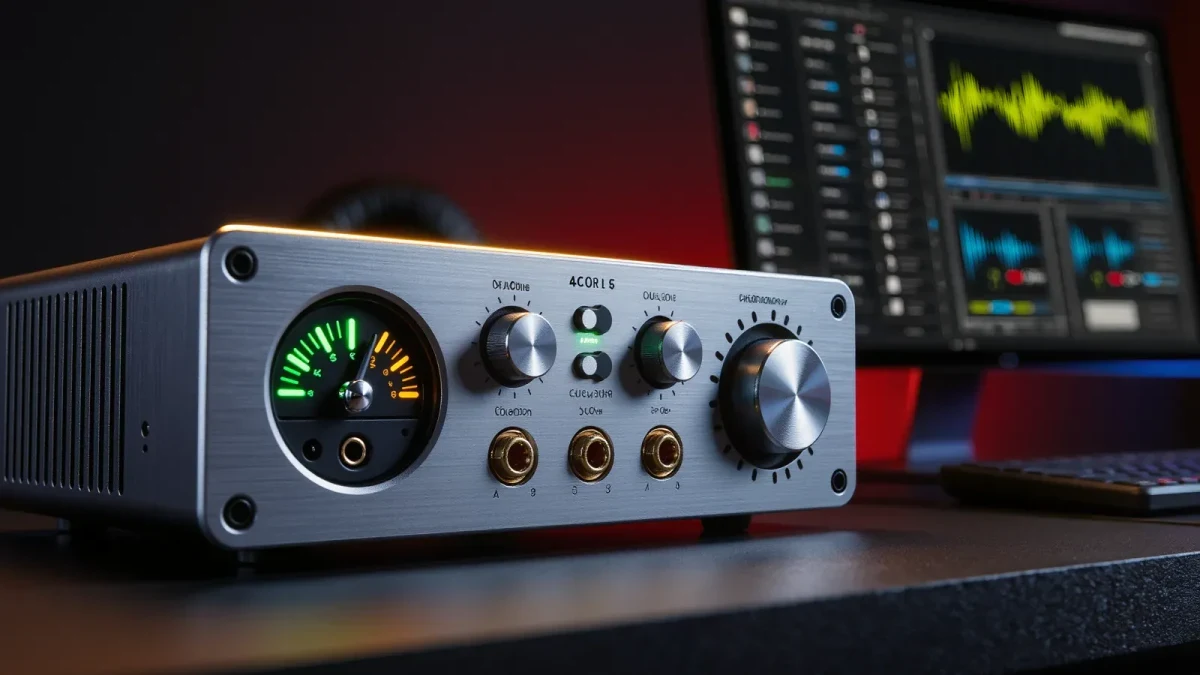
Hi-res audio — recordings at 24-bit depth and sampling rates of 88.2 kHz or above — is measurably superior to CD quality and audibly indistinguishable from it in controlled tests, and both statements rest on firm science. Human hearing tops out near 20 kHz in childhood and declines with age; CD sampling at 44.1 kHz already captures everything up to about 22 kHz, and 16-bit depth provides roughly 96 dB of dynamic range, far beyond any listening room's usable span. Higher rates add ultrasonic frequencies you cannot hear and dynamic range you cannot use. The question «worth it?» is therefore not about audibility — the measurements settled that — but about masters, guarantees, and what listeners value beyond their ears.
AA Digital Sound publishes information, not purchasing advice; this analysis presents documented research in hearing science and codec engineering.
What does 24-bit / 192 kHz actually buy?
Two things, both real and both mostly outside perception. Bit depth sets the noise floor: each bit adds about 6 dB of range, so 16 bits give ~96 dB and 24 bits give ~144 dB — headroom no playback chain in a home, sitting above any ambient noise floor, can use. Sampling rate sets the frequency ceiling: 192 kHz records frequencies up to 96 kHz, an octave and a half beyond bats' territory and roughly five times beyond human limits. In production, that range has documented uses — some time-alignment and processing operations behave better with oversampled material — which is why studios record hi-res. Distribution is a different matter.
What do the listening tests show?
Consistently, over two decades: trained listeners, on excellent equipment, fail to identify hi-res over CD quality at rates beyond chance. The largest widely cited efforts — the Meyer and Moran experiment published by the Audio Engineering Society in 2007, and a 2014 meta-analysis of prior tests by researcher Joshua Reiss — found no reliable evidence of audible superiority, with the meta-analysis concluding that any effect, if present, is small. Meanwhile the documented cases where listeners genuinely heard «hi-res» versions sounding better were traced to a different cause: the hi-res files used different — often less compressed — masters. Listeners were hearing mastering decisions, not sample rates.
Why do some hi-res releases sound better anyway?
Because of the master, the actual lesson of the hi-res era. A hi-res tier's catalog is often remastered with more dynamic range, or sourced from earlier, less-processed transfers, or simply delivered without the loudness-war compression applied to the standard version. The ultrasonic content is irrelevant; the dynamics are not. This is why the practical advice repeated across measurement communities is blunt: compare masters, not bit depths. A well-mastered 16/44.1 stream of a dynamic transfer beats a 24/192 file of a crushed master on any equipment, anywhere, measurably.
Is there any harm in ultrasonic content?
Possibly — an underappreciated documented wrinkle. Ultrasonics that pass through amplifiers and tweeters can intermodulate, generating audible distortion products in the hearing band; some engineers argue playback gear should simply filter them. Whether that effect is audible on given equipment is contested, but the existence of the mechanism is standard electronics. It complicates the «more is safer» intuition: content you cannot hear can, in some chains, degrade content you can.
What is hi-res genuinely good for?
Three documented cases. Archival: lossless hi-res files preserve future-proofing for a master whose best transfer is worth keeping at full fidelity. Production: as noted, recording and processing at high rates has engineering benefits before distribution. Psychology: listeners who know the file is hi-res report better experiences — expectation effects are documented components of perception, not delusions, and a listener who relaxes into a favorite record because the badge says hi-res is hearing something real about enjoyment, if not about frequencies. None of these requires believing ultrasonics are audible.
What about «hi-res certified» equipment?
Hardware badges deserve the same measured skepticism. A «hi-res» logo on a headphone or speaker certifies that the device can pass or reproduce ultrasonic frequencies — an ability that says nothing about performance inside the hearing band, where a flat response and low distortion are what matter. Measurement reviewers have long noted certified gear with audible-range flaws, and unbadged gear with superb in-band performance. The specification is real; its marketing value exceeds its sonic meaning. For listeners, the in-band measurements remain the ones to read.
So what should a listener conclude?
That the hierarchy of audible improvements runs: master quality first, then playback equipment and room, then lossless over low-bitrate lossy — and hi-res somewhere after all of them, unmeasurable by ears. The measurements do not say hi-res is a fraud; the files genuinely contain more information. They say the extra information targets equipment and frequencies humans do not have. Spend on the room, the headphones, and well-mastered releases — and if a hi-res tier includes the good masters along with the big numbers, that, documented irony of the streaming age, is the part of the purchase that reaches your ears.