The producers behind signature sounds — Phil Spector's Wall of Sound, Quincy Jones on Thriller, Dr. Dre's G-funk, Brian Eno's ambient systems — shaped records as recognizably as the artists who fronted them. Spector's "River Deep – Mountain High," produced with Tina Turner in 1966, was a commercial disappointment in America on release, yet critics have treated it for decades since as the Wall of Sound's summit, a judgment the Rock & Roll Hall of Fame echoed by inducting Spector in 1989.
A producer's signature sound is a repeatable sonic identity — a set of choices about arrangement, space and recording method that carries from record to record regardless of who is singing. What follows is a profile of the documented cases critics and engineers have written about longest.
What was the Wall of Sound, actually?
It was an arrangement idea executed as a recording method. Phil Spector gathered large ensembles — multiple pianos, guitars doubling orchestral parts, strings — in Gold Star Studios in Los Angeles and mixed them into a single dense wave of echo, a technique intended, as Spector described it, to make records that sounded right on a car radio or a transistor set. Hits like the Ronettes' "Be My Baby" (1963) and the Crystals' "Da Doo Ron Ron" (1963) established it; by 1966 he was applying it to Ike and Tina Turner. The critical rehabilitation of "River Deep – Mountain High" — praised on release in Britain, overlooked in the U.S., and reconsidered by generations of critics after — is one of the most documented re-assessments in pop history.
How did Quincy Jones define the biggest album of the 1980s?
By preparation. Jones, a former big-band arranger who had already produced Michael Jackson's Off the Wall in 1979, ran the Thriller sessions of 1982 with a casting producer's logic: Eddie Van Halen's guitar solo on "Beat It," the Vincent Price narration on "Thriller," the rock and funk and disco elements balanced into something no radio format could reject. Thriller spent 37 weeks at No. 1 on the Billboard 200, won a then-record eight Grammy Awards in 1984, and its production choices — the tight drum sound, the arranged countersubjects — have been itemized in engineering press ever since.
Which producers built genres rather than hits?
Three cases stand out in the documented record. Dr. Dre's G-funk — the high, whining portamento synths and live-feeling bass of 1992's The Chronic — defined West Coast hip-hop for a decade and made Snoop Dogg's voice a national sound before his own debut. Rick Rubin, co-founder of Def Jam Recordings in 1984, stripped hip-hop to drums and voice on LL Cool J's "Radio" (1985) and later applied the same spare approach to Johnny Cash's American Recordings (1994), one of the most cited production reinventions in American music. And Brian Eno, who developed ambient music on albums like Ambient 1: Music for Airports (1978), brought studio-as-instrument thinking to Talking Heads' Remain in Light (1980), co-credited as producer with the band.
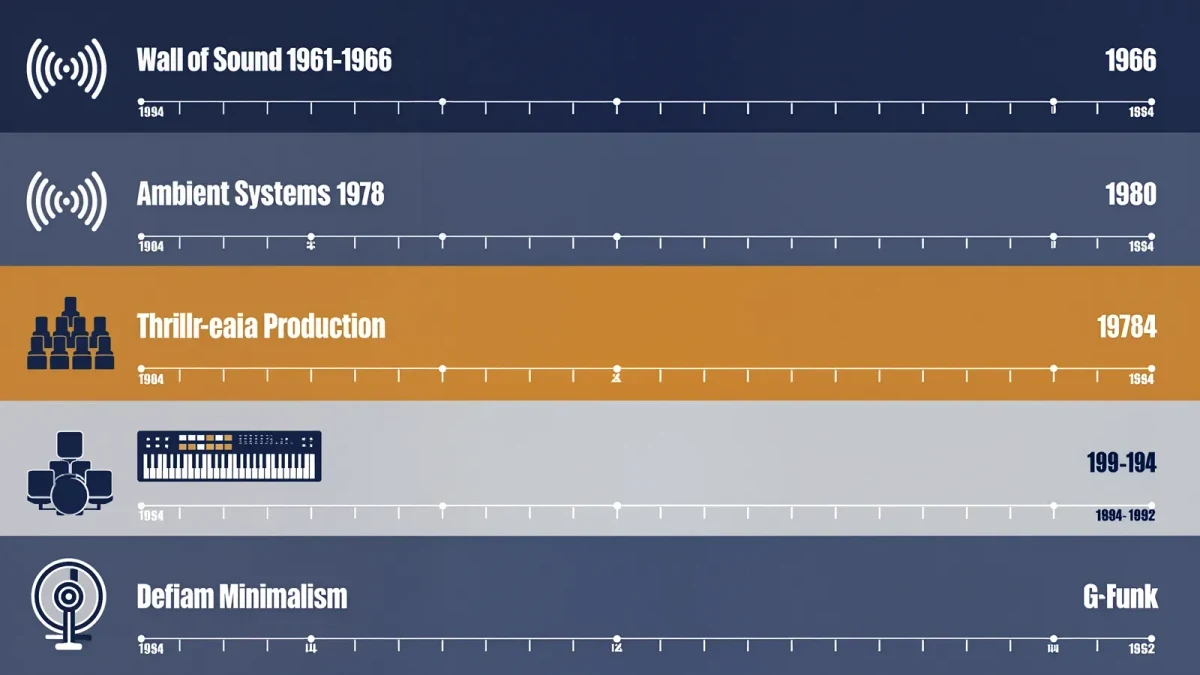
- Phil Spector — Wall of Sound, Gold Star Studios, 1961–1966.
- Quincy Jones — Off the Wall (1979), Thriller (1982), eight Grammys in 1984.
- Dr. Dre — G-funk on The Chronic (1992).
- Rick Rubin — Def Jam's spare hip-hop (1984–), Cash's American Recordings (1994).
- Brian Eno — ambient systems (1978–) and the Talking Heads trilogy.
What makes a signature sound repeatable?
The documented answer is constraint. Spector used the same room and the same echo chamber; Dre's signature depended on specific synthesizer lines and a mixing discipline he has described in interviews across decades; Jones's depended on arranging discipline learned in big bands. Critics writing on production history — among them the engineers and journalists polled for legacy retrospectives on Thriller's fortieth anniversary in 2022 — consistently note that repeatable identity comes from a producer's method, not a piece of gear.
The through-line from Gold Star to Compton is that a signature sound is a decision repeated under pressure. The producers above made the same decision often enough that listeners learned to hear it — and the artists they worked with carried it onto the radio whether the format was ready or not.
How did Motown build a house sound?
With a system. Berry Gordy's Detroit operation, formalized after the company's 1959 founding, ran weekly quality-control meetings and a staff arrangement pipeline in which producers and musicians — the Funk Brothers, the house band whose contribution to the label's hits was documented decades later — shaped every record to a shared standard. Producers including Norman Whitfield, who steered the Temptations from sweet soul toward the harder psychedelic-soul of "Cloud Nine" (1968) and "Ball of Confusion" (1970), showed how a house style could evolve without losing its identity. Hitsville U.S.A.'s Studio A, a converted garage, produced a run of No. 1 singles through the 1960s that trade press and chart archives document in detail — the clearest American counterpart to Spector's single-room method, and the model later labels studied when they talked about developing a sound rather than signing a song.