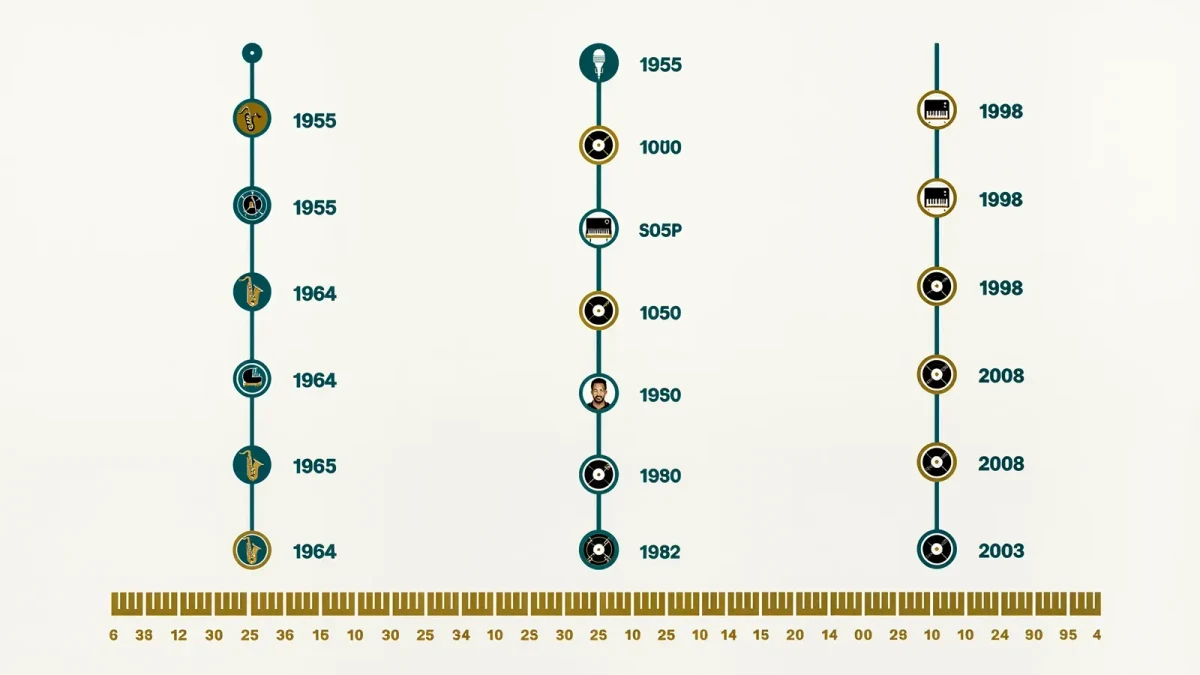
The mentorships that shaped music history form documented chains: Miles Davis hiring John Coltrane in 1955 and pushing the saxophonist toward the relentless practice that became his method; Quincy Jones, barely twenty, arranging for Ray Charles in Seattle in the early 1950s; Dr. Dre signing Eminem in 1998 after hearing one demo tape. Each link is on the record — in band rosters, label announcements and the musicians' own retrospective interviews — and each shaped a sound that defined its era.
Mentorship in music is not a formality: it is the transmission of a working method, a booking, or a producer's conviction at the moment it matters. The cases here were chosen because the documentation runs deep.
What did Miles Davis give John Coltrane?
A band and a standard. Davis hired Coltrane in 1955 for the quintet that recorded for Prestige and Columbia; the group's classic run ended in 1960, by which point Coltrane's "sheets of sound" period — a term critic Ira Gitler coined in 1958 — had made him an influence in his own right. Coltrane's disciplined practice habits, documented by bandmates and historians, matured inside Davis's band, where the leader's editing instinct — what to leave out — was the daily lesson. Coltrane then led his own quartet from 1960 to 1965, recording A Love Supreme in December 1964, and the chain continued: pianist McCoy Tyner and drummer Elvin Jones carried his influence forward into the next generation's leadership.
How did Ray Charles teach Quincy Jones?
By proximity in Seattle, around 1950–1952, when Jones was a young arranger and Charles a rising bandleader in the city's club scene. Jones has described those years in interviews and memoir as his education in arranging and bandleading; the friendship lasted until Charles's death in 2004. Jones's later production career — Count Basie arrangements, film scores, then Michael Jackson's Off the Wall (1979) and Thriller (1982) — applies big-band discipline to pop, a transfer critics have traced to those Seattle years. Jones in turn mentored generations of engineers and producers, making the chain one of the longest in recorded music.
Which modern mentorships changed the charts?
The Dr. Dre–Eminem case is the most documented. In 1998, after Eminem's The Slim Shady EP reached him through Interscope's Iovine pipeline, Dre signed the Detroit rapper to his Aftermath label and produced The Slim Shady LP (February 1999), which debuted inside the Billboard 200's top three and won the Best Rap Album Grammy in 2000. Eminem's own label, Shady Records, then signed 50 Cent in 2002 — Get Rich or Die Tryin' (2003) became one of the fastest-selling debuts on record — extending the mentor chain into a third chart-ruling generation.
- Davis → Coltrane — 1955–1960 quintet; A Love Supreme (1964) downstream.
- Charles → Jones — Seattle, circa 1950–52; Thriller (1982) downstream.
- Dre → Eminem → 50 Cent — Aftermath/Shady, 1998–2003, three generations of No. 1 records.
- Berry Gordy → Smokey Robinson — Tamla Records' first artist and its vice president by the mid-1960s, a documented inside-the-company mentorship that built the Motown songwriting system.
Why do mentor chains matter to listeners?
Because they explain why styles move. The BBC's documentary coverage of Motown and of British jazz — the latter's own lineage of bandleaders teaching sidewomen and sidemen is a running theme in its arts reporting — treats mentorship as the engine of genre transmission: not radio formats or marketing, but one musician hiring another and raising the standard nightly. The chains above account for hard bop's evolution, the production craft of the biggest-selling album ever, and three linked generations of rap chart-toppers.
The pattern's quiet lesson is that mentorship in music is employment first. Davis gave Coltrane a gig, Charles gave Jones arranging work, Dre gave Eminem a contract. Everything the word "mentor" implies grew out of the practical act of paying someone to play.
How does mentorship work outside the label system?
Through bands, scenes and teaching chairs. The jazz lineage is the deepest documented case: pianist Thelonious Monk's influence on a generation of saxophonists and composers ran through bandstand proximity rather than contracts, and college programs — Berklee in Boston, Juilliard in New York — became formal mentors-in-residence from mid-century onward, their alumni rosters reading as a history of post-war American music. In folk and blues, the Newport Folk Festivals of the early 1960s placed young rediscovery-era performers beside the elders whose catalogs they had studied, a documented pairing visible in the festival's own programs. Hip-hop's version is the crew: the Dungeon Family collective in Atlanta, OutKast's development ground, or the Minneapolis scene that produced Prince's associated artists in the 1980s. What the non-label cases share is apprenticeship by exposure — nightly performance, shared studios, passed-down standards — rather than a signature. The music industry formalized what scenes had always done, and the chains above simply ran through both channels at once.