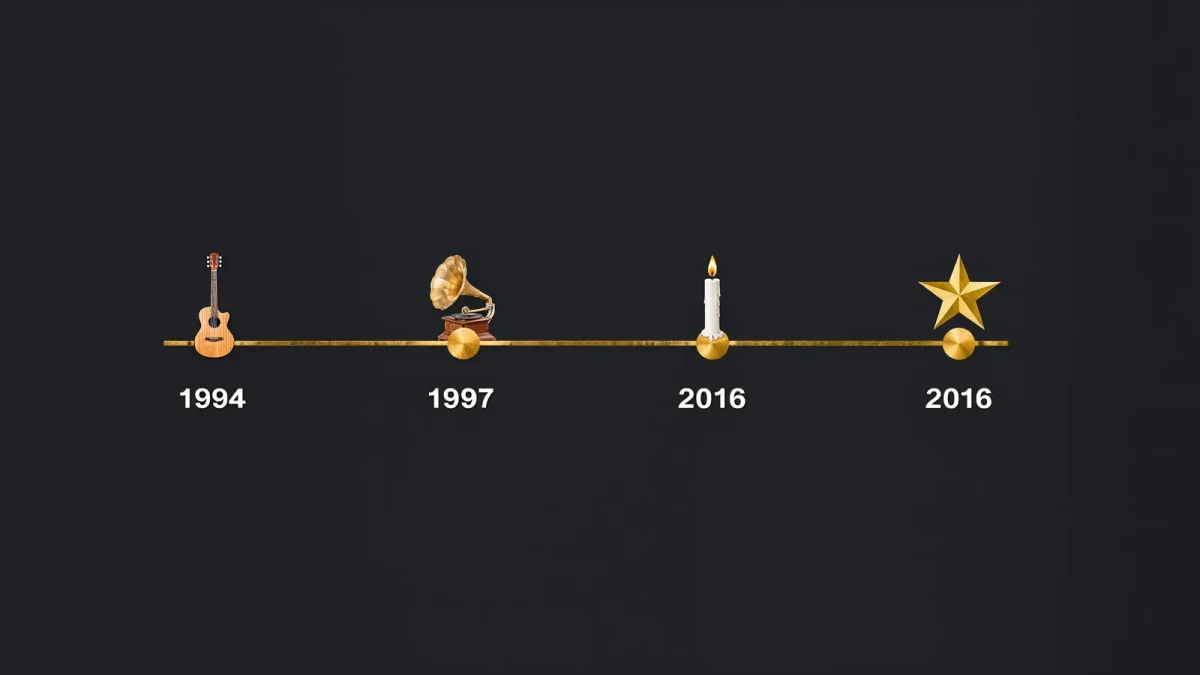
Some artists make their best record late in a career because age removes what critics have long identified as the obstacles to a great album: commercial obligation, producer interference and the pressure to repeat. Johnny Cash's American Recordings (1994), recorded when he was 62, returned him to critical favor after years outside Nashville's mainstream; Bob Dylan's Time Out of Mind (1997), made at 56, won the 1998 Grammy for Album of the Year; Leonard Cohen's You Want It Darker (2016), released weeks before his death at 82, was received as a final summation. Each case is documented — and each has specific, traceable conditions.
A late-career masterpiece, in this profile, is a record critics and institutions treated as standing with or above an artist's best work, released two or more decades into a career. The judgment is theirs; the conditions are what the record documents.
What conditions produced Cash's American Recordings?
A producer's conviction and a stripped setup. Rick Rubin — then known for hip-hop and hard rock — approached Cash in 1992, and the sessions that became American Recordings (April 1994) were mostly voice and acoustic guitar, recorded in Cash's cabin and in Rubin's living room, as the liner notes and subsequent documentation describe. The repertoire mixed Cash's own songs with contemporary writers' material — Soundgarden's "Rusty Cage" among them — placing a country voice outside its genre machinery. The album won the 1995 Grammy for Best Contemporary Folk Album and began a series that ran until the posthumous American VI in 2010. Critics writing on Cash's death in September 2003, in coverage BBC News documented worldwide, treated the Rubin years as a third act no one had forecast.
How did Dylan arrive at Time Out of Mind?
Through a documented creative drought and a changed relationship to his own voice. Dylan had described his late-1980s and early-1990s output in interviews as unfocused; Time Out of Mind (September 1997), produced with Daniel Lanois, was his first album of new original songs in seven years. Its themes — mortality, memory, love past rescue — were widely noted by critics, several of whom connected the record to the writer's own late period. The 1998 Album of the Year Grammy was Dylan's first in that category; the Pulitzer Prize Board's 2008 special citation for his impact on popular music followed the same reassessment arc.
What role does mortality play in the documented cases?
A specific one: several of the strongest late records were made with the artist's death visibly near, and the critical reception took that proximity into account. Cohen's You Want It Darker (October 2016) was released three weeks before his death on November 7, 2016; David Bowie's Blackstar (January 8, 2016) arrived two days before his death on January 10, and its descent into illness-themed imagery was recognized almost immediately afterward — BBC News's coverage of the album and the days that followed documented the shock of reading the record as a farewell. Historians caution against reducing these albums to obituaries: both were finished as deliberate works, with Cohen's son Adam producing and Bowie co-writing with his long-time producer Tony Visconti. But the reception history is inseparable from the timing.
- Cash, American Recordings (1994) — producer match, stripped format, genre escape; 1995 Grammy.
- Dylan, Time Out of Mind (1997) — drought broken, mortality themes, 1998 Album of the Year Grammy.
- Cohen, You Want It Darker (2016) — released three weeks before his death, at 82.
- Bowie, Blackstar (2016) — released two days before his death, read as a composed farewell.
Is there a pattern listeners can rely on?
A partial one, drawn from reception history rather than guarantees. The documented late masterpieces cluster around four conditions: a trusted collaborator outside the artist's usual system (Rubin, Lanois, Visconti); a format stripped enough to suit an older voice; repertoire chosen for meaning rather than radio; and — in the strongest cases — an artist treating the record as potentially final. Critics noting the pattern, including the retrospective essays that followed the deaths of Cohen and Bowie in 2016, tend to describe these albums as the rare records where career, craft and time press on the same page. That is why they are played decades on: the stakes are audible in the recording, whatever the chart said that week.
Which living artists fit the pattern?
Several, and the list keeps growing as careers lengthen. Paul Simon's So Beautiful or So What (2011), made at 69, was received by several major critics as his best work in two decades; Lucinda Williams's run of late-2010s and 2020s albums, recorded after a 2020 stroke, drew the same reception notes — critics describing an artist freed from any obligation but the song. Nick Cave's documented turn toward grief-writing after 2016, with the Skeleton Tree and Ghosteen albums, is treated in critical literature as a late-career deepening rather than a decline. What these cases share with the canonical four is timing and method: stripped setups, trusted collaborators, songs written without radio in mind. The commercial fate varies — some topped genre charts, others reached smaller audiences than the artists' peak years — but the reception pattern holds. The late masterpiece is not a promise; it is a documented possibility, and the conditions that produce it are visible enough in the record to study, copy where they can be copied, and respect where they cannot.