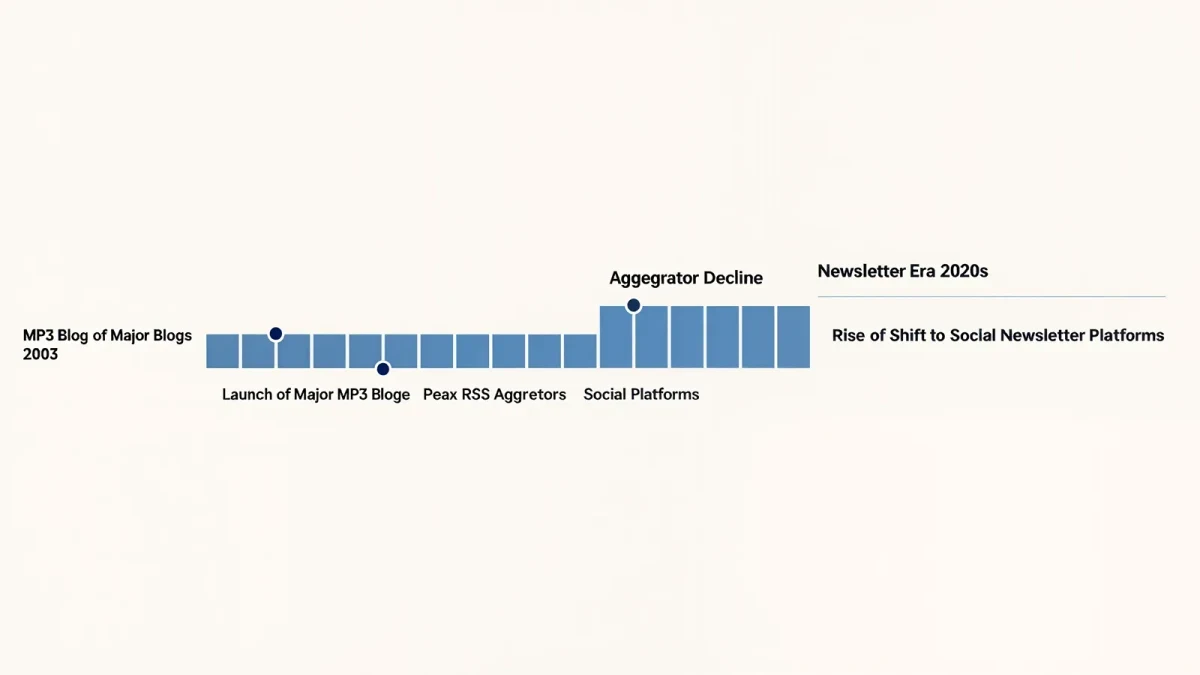
Yes, music blogs still break artists in 2026 — fewer of them, and less noisily than in the 2003-2011 boom, but the function survived. The pattern repeats in documented case after case: a small outlet with a defined taste writes about an unknown early, the post circulates through forums and playlists, and a year later the industry catches up. What changed is scale and format. The era's infrastructure moved into Substack newsletters, genre-specific sites and long-running independents, and the readers who benefit most are the ones who know how the surviving blogs actually work.
AA Digital Sound writes about discovery infrastructure here as an observer — this piece names no living blog URLs, and the historical examples come from documented coverage.
What was the MP3-blog era, and why did it matter?
Between roughly 2003 and 2011, hobbyist sites posting individual songs became the fastest filter in music. The documented cases are canonical: a fledgling site called Hipster Runoff and the aggregator HypeFM-style ecosystems mattered less than the simple mechanic — one writer, one song, one day. Arctic Monkeys' early audience assembled on forums; Lana Del Rey's "Video Games" traveled through blogs before any label campaign in 2011; the Weeknd's first mixtapes arrived in 2011 with no interviews and a web-native rollout that the press described as blog-driven. The gatekeepers were readers with bandwidth, not programmers.
Why did that era collapse?
Three forces, all well documented. Streaming pulled audiences into platforms where playlists replaced posts as the unit of discovery. Social feeds — and later short-video algorithms — became faster distribution than any blogroll. And the economics of writing collapsed: display advertising paid pennies, and most MP3 bloggers were hobbyists who burned out or went professional elsewhere. The aggregators shuttered one by one through the 2010s. What looked like the death of music blogging was really the death of a business model; the editorial function never disappeared.
Who carried the function forward?
Three heirs, each documented. Long-running independents — the survivors of the boom years — kept editing with the same small staffs and defined tastes, and continued to break artists at their historical pace. Newsletter-era critics moved to subscription platforms, where a single trusted writer with a free tier can move a record the way a blog once did, minus the comment section. And genre-specific micro-sites — industrial, regional folk, footwork, jazz reissues — inherited the crate-digger role, going deeper than any general-interest outlet can. Reuters and other outlets covering digital media have tracked the same migration of readers and writers from ad-funded blogs to newsletters through the late 2010s and 2020s.
What do the surviving blogs do differently?
- A defined beat — a genre, a city, an era — instead of general coverage.
- Names on the writing, so taste is accountable and followable.
- Long archives, which new readers mine like discographies.
- Slower cadence by choice — fewer posts, more conviction per post.
- Direct reader funding, which replaced the advertising that killed the boom.
How do you read blogs usefully for discovery?
Read for the writer, not the premiere. Premiere posts — where labels hand an outlet an exclusive stream — are marketing infrastructure, useful but compromised as a filter. The posts that break artists are usually the unsolicited ones: a writer covering a local act nobody pitched, a round-up of demo submissions, a scene report from a city the industry is not watching. The practical habit is the blogroll move, revived: when a writer you trust links to another writer, follow the link. Trust networks are still how the small press reproduces itself, and two degrees of that chain will outperform any algorithmic feed for unfamiliar music.
How do you tell a living filter from a zombie site?
Check three things. Recency of unsolicited coverage — a site that only runs label premieres is a billboard, not a filter. The comment or reply culture, where present, tells you whether a community reads it or a search engine does. And consistency of taste across time, readable in the archive: a filter earns trust by being wrong in interesting, correctable ways, not by chasing whatever the referral traffic rewards. BBC Culture's coverage of online music writing has made the same point from the critical side — the outlets that matter are the ones whose judgment survives being checked.
What did the survivors learn from the collapse?
Mostly, to stay small on purpose. The boom-era sites that lived tried to be everything to every reader and drowned in their own posting volume; the ones that endured narrowed — one genre, one city, one format — until the audience matched the output. Direct reader funding completed the lesson: when readers pay, the editor's loyalty settles with them, not with advertisers or referral traffic, and the coverage visibly changes. Premature obituaries of music writing have appeared regularly since the 2010s, and each wave has been followed by a new class of small outlets doing the same job under different plumbing. The lesson for readers is to stop waiting for a destination and start following people.
A premiere is a label speaking through a site; a scene report is a filter speaking for itself. Learn the difference and the small press becomes legible.