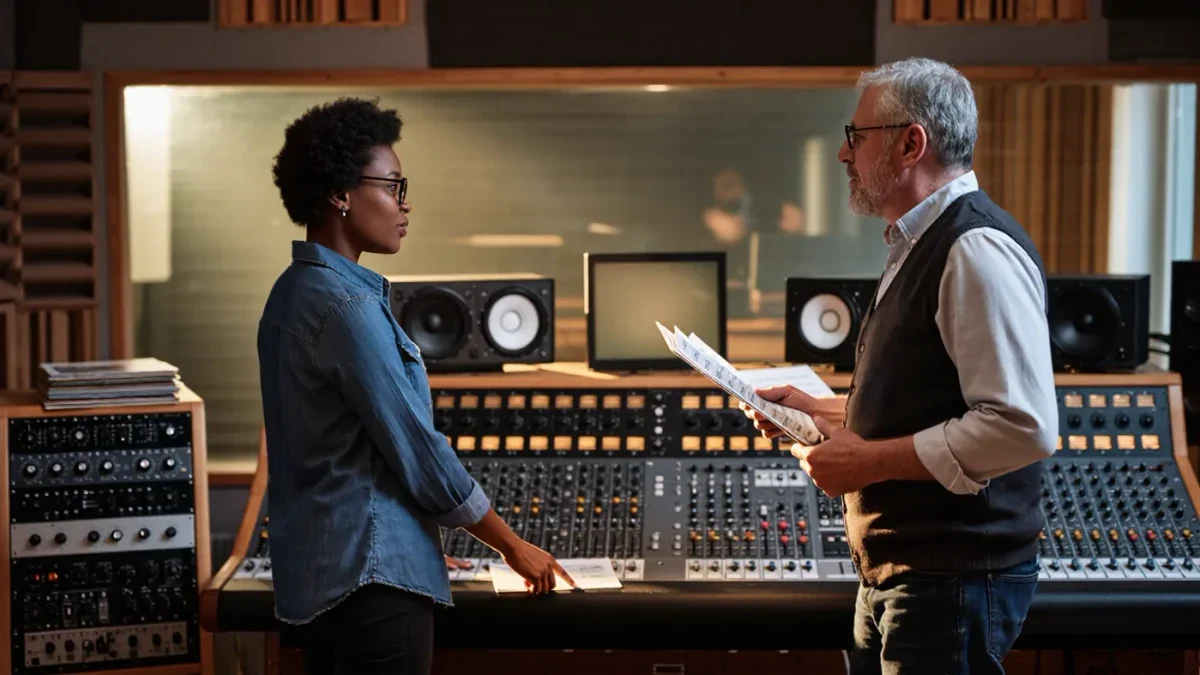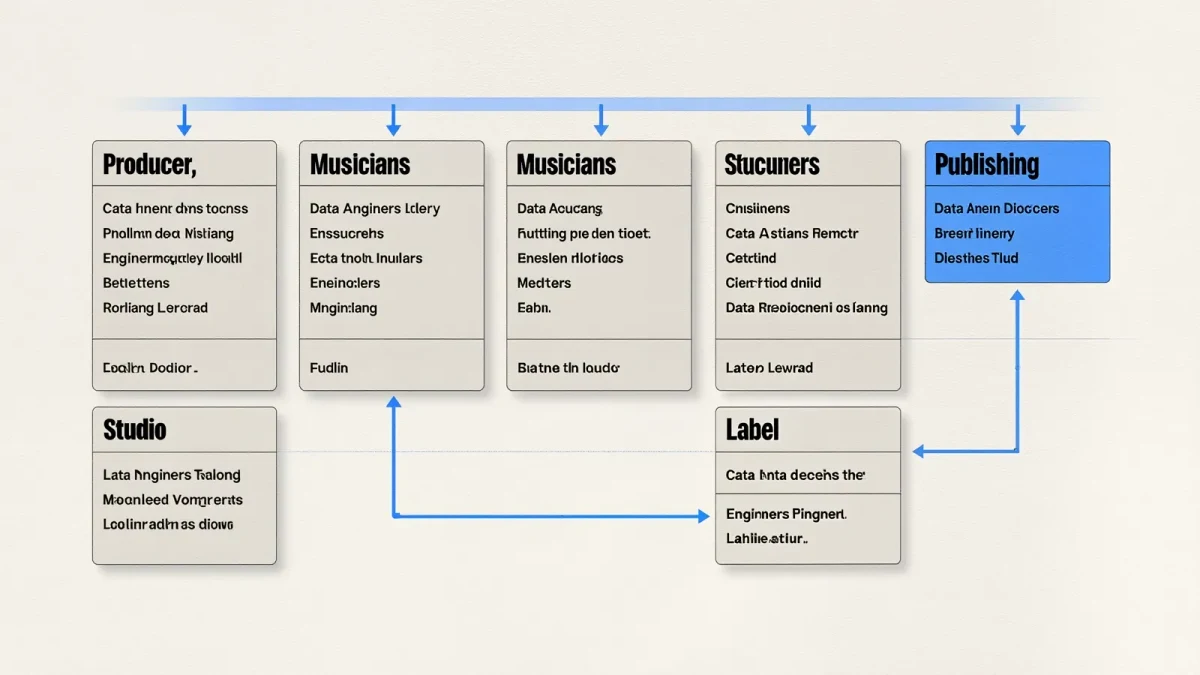
Liner notes are the printed material around the music — producer and musician credits, studio and engineer details, publishing data, thank-yous — and reading them well turns every album you already love into a discovery engine. One producer credit links a Nashville session to a Liverpool debut; one studio name connects a Lagos afrobeat reissue to a Brazilian classic. The skill is knowing what each block of the credits page tells you, and which lines are worth chasing. It is the cheapest research method in music, and it has been the crate-digger's primary tool since the format existed.
AA Digital Sound writes about records as documented objects; every claim below traces to verifiable credit conventions and recorded-music history, not to listening impressions.
What are the parts of a credits page?
A standard album credit block has a predictable anatomy, on vinyl sleeves as on streaming metadata. Producer and co-producer lines come first — the people responsible for the record's overall sound decisions. Then per-track musician credits, listing who played what, increasingly including session and remote contributors. Engineers follow: tracking, mixing and mastering engineers, each a distinct craft. Then the institutional lines — the studio and its location, the label and catalog number, publishing companies, and copyright and legal lines. Finally the prose: thank-yous, dedications and sometimes the essay-length liner notes that jazz and classical releases made an art form.
Which credits carry the most information?
- Producer — the strongest single indicator of what a record will sound like; producers build recognizable methods across artists.
- Mixing and mastering engineers — sonic signatures that travel between genres and reveal scene networks.
- Session players — the connective tissue of whole eras, like the documented house bands of Motown, Stax and Muscle Shoals.
- Studio and location — places with their own sound, from Abbey Road's rooms to the documented American South studios of the 1960s and 1970s.
- Sample clearances and interpolation credits — direct pointers to the older records a new one is built from.
How do you turn a credit into a discovery?
Chase one name per sitting, and chase sideways first. If a bassist appears on an album you love, find two more records with the same name — the pattern, not the single credit, tells you whether the player or producer is the taste-lever. Follow producers backward into their earlier work, which is where underrated records hide. Sample clearances are the richest trail of all: a clearance credit hands you the exact source record, and one sample trail led a generation of listeners from 1990s hip-hop back to the funk catalogs it was built on — the documented effect that drove reissue programs throughout the 1990s and 2000s.
What can thank-you lists tell you?
More than they pretend to. Thank-yous are the social graph of a scene: managers, other bands, venues, radio stations, local studios. A debut album's thank-you list often names the entire local infrastructure that produced the artist — the college station, the record store, the practice space — which is scene research you cannot buy. Historically, thank-yous tipped listeners to collaborations before they were announced, and label rosters can be reconstructed from them: the same small label thanked across five bands' debuts is a curated catalog in disguise.
How do you read credits in the streaming era?
The credits moved, and became patchier, but they did not vanish. Major platforms carry per-track credits — writers, producers, sometimes full session personnel — populated from label metadata, and gaps are common on older and independent releases. When the platform's block is thin, the label's release page or the physical reissue usually carries the full sheet. For historical work, the Library of Congress's National Jukebox and related catalogs document performance and provenance data reaching back more than a century, and discographic databases have compiled session credits for decades — the jazz discography tradition being the deepest, with its documented practice of tracing players session by session since the 1930s.
What are the classic insider reads?
A few conventions reward knowing them. "Produced by" plus the artist's own name usually signals self-sufficiency — or label neglect, and the context tells you which. A&r credit placement mattered enormously in the vinyl era and still marks who championed a record internally. "Recorded at" plus a famous room is a sound signature: some studios' acoustics are audible once you know to listen. And an unusually long musician list on a pop record means real players, not programming — a distinction worth checking before any claim about a record's craft. Read enough sheets and credits stop being fine print; they become the music world's newspaper, printed one line per contributor.
Where do credits still get lost?
Three documented gaps. Older catalogs often carry only a producer and label line, with session musicians unrecorded — a hole discographers have spent decades filling for jazz and soul, sometimes from memory and photographs. Streaming metadata is voluntary and inconsistent, so uncredited contributions surface years later in interviews and litigation reporting. And the creative labor beyond performance — the engineers, arrangers and programmers who shape records — remains systematically under-credited across eras, a gap the industry's own professional bodies have campaigned against for years. Reading credits critically means knowing the page is a document written by people with budgets and blind spots, not a neutral ledger.
Every credit is a name with a discography behind it. Chase one name per record and a single shelf becomes a lifetime of leads.