An artist releases a song and, within a week, it's spinning on a handful of college and community stations hundreds of miles apart. That doesn't happen by accident, and it doesn't happen through a streaming algorithm. It happens because a person — usually a student or volunteer with the title of music director — listened to the track, decided it belonged in rotation, and told other people about it.
Understanding that chain matters for anyone who cares how new artists actually get discovered, because it's one of the few discovery paths left that runs on human judgment rather than listening history and skip rates.
What does it actually mean for a station to "add" a song?
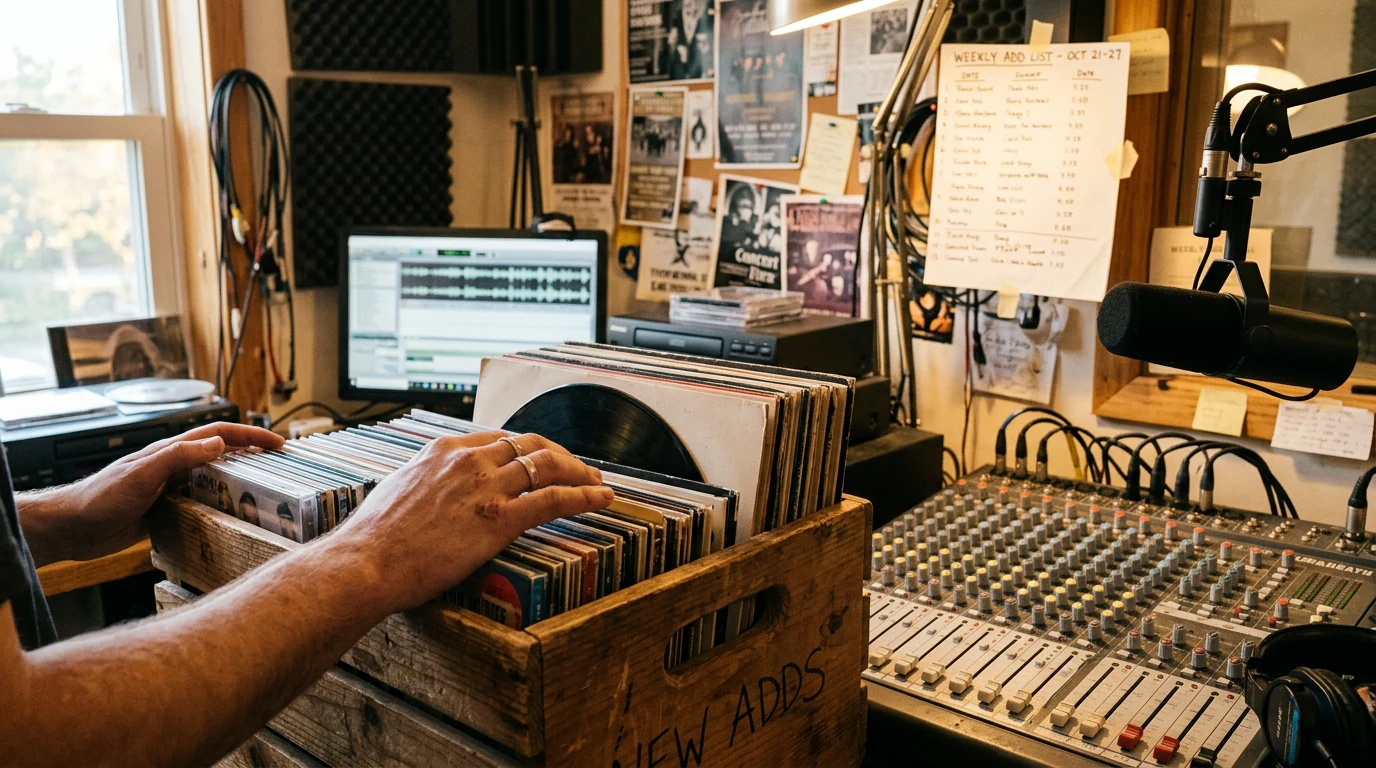
"Adding" a track means a station's music director has formally placed it in rotation — the pool of songs DJs are expected to play during their shows, as opposed to something a single DJ might spin on their own. At CFUV, the community station at the University of Victoria, music director Troy Lemberg described the mechanics of that process to Bandcamp Daily: he sends "an email every week that has a list of all the new music added, plus a selection of releases I highlight that I think are the standout ones," with the albums themselves placed in a promo folder linked from that newsletter [SRC-02]. New music also physically goes out to DJs around the station each Monday or Tuesday, and mid-week arrivals get flagged in a programmer Facebook group, often with a link to the artist's Bandcamp page [SRC-02].
That's one station's system, but the shape repeats across the format: a gatekeeper reviews submissions, curates a shortlist, and pushes it out to a roster of on-air hosts who then decide, show by show, what actually gets airtime.
Who is actually making these calls, and why does it matter for an artist?
The person making the add decision is rarely a programming executive. College and community radio stations are staffed largely by students and volunteers, and the music director role often rotates from year to year. That turnover is part of why the format is considered an early-signal source: a new music director brings a fresh set of ears and a fresh set of genre interests every season, which keeps any single station's taste from calcifying.
This is also why the format keeps surfacing acts before they're widely known. As NPR's World Cafe put it in a December 2025 piece on algorithm-free listening, "students manning college radio stations across the U.S. are always some of the first to identify new music trends and spotlight rising acts" [SRC-03]. That's a judgment call made by a listener, not a recommendation engine trained on aggregate play data.
How does an add at one station turn into something an artist's team can actually point to?
A single station's playlist is a local signal. What turns scattered adds into a measurable trend is charting — and in the college and community format, that's the job of the North American College & Community Chart, or NACC. Stations report their airplay to NACC directly, with a music or program director providing the station's call letters and market to get set up as a reporter [SRC-01]. NACC then compiles that data into weekly rankings, including its flagship NACC 200 and a set of genre-specific charts, along with a "Top Adds" list that tracks which songs picked up the most new station adds in a given week [SRC-01].
Labels, publicists, and stations themselves use those charts as an industry reference point — a way to see whether a track that's getting added at one station in one city is also getting added at forty others. NACC also recognizes individual music directors on a monthly basis, a small acknowledgment that the chart is built entirely from decisions made by named people at named stations, not from passive listening data [SRC-01].
Why does this still matter when streaming services already have discovery playlists?
Algorithmic playlists are built to predict what a listener is statistically likely to enjoy based on what they and similar listeners have already played — which tends to reinforce existing taste rather than challenge it. College and community radio's system runs the opposite direction: a person picks a song because they think it's worth hearing, independent of whether it resembles anything already popular with that station's audience.
That distinction has been getting renewed attention as listeners express fatigue with algorithm-driven feeds. NPR's World Cafe described the appeal of human-curated listening as "personal, human-centric and algorithm-free," tying it to a broader craving among listeners for "more intentionality with our music" [SRC-03]. College radio's add process — a real person deciding a song is good enough to hand to other real people — is a version of that intentionality that predates the streaming era by decades and never went away.
How can a listener find what these stations are actually playing?
Most college and community stations stream online and post their current or recent playlists on their own websites, which is the most direct way to hear what a given music director has added that week. NACC's public rankings are another entry point for anyone who wants to see which songs are landing across many stations at once rather than just one [SRC-01]. Either route leads to the same place: music that made it onto the air because someone chose it, not because a model predicted a click.